



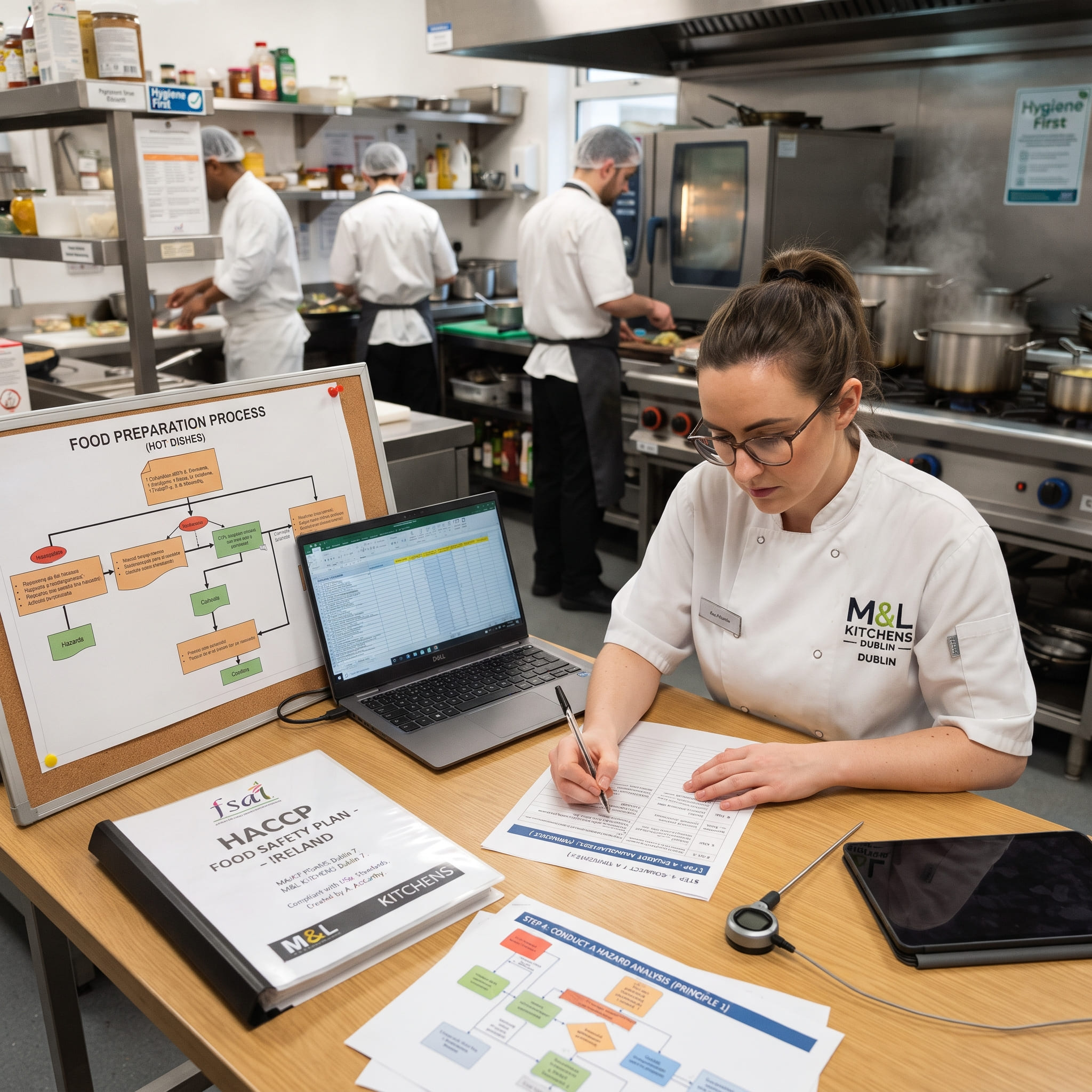
A HACCP food safety plan is an important part of managing food safety in businesses that prepare, handle, store, transport or serve food. It provides a structured way to identify potential food safety hazards and establish controls to prevent those hazards from affecting customers.
For businesses in Ireland, developing an effective HACCP system is an important part of food safety management. A good plan should reflect the actual activities of the business rather than being a generic document copied from another food operation.
Whether you operate a restaurant, café, takeaway, bakery, catering business, food shop or another food-related operation, understanding how HACCP works can help you establish practical food safety controls.
This guide explains the main components of a HACCP food safety plan, who should be involved and how businesses can keep their system effective over time.
What Is a HACCP Food Safety Plan?
HACCP stands for Hazard Analysis and Critical Control Points.
A HACCP plan is a documented system that identifies significant food safety hazards and establishes controls for managing them.
The plan considers the food process from beginning to end.
This can include:
- Receiving ingredients
- Storage
- Preparation
- Cooking
- Cooling
- Reheating
- Service
- Transportation
- Cleaning
The exact stages depend on the business.
The Food Safety Authority of Ireland (FSAI) describes HACCP as a systematic approach to identifying and controlling food safety hazards.
Why Does a Food Business Need a HACCP Plan?
A HACCP plan helps a business move from simply reacting to food safety problems to identifying potential problems before they occur.
A good system can help a business:
- Identify food safety hazards
- Establish appropriate controls
- Monitor important processes
- Respond to problems
- Maintain records
- Verify that controls are working
It can also help employees understand what is expected of them.
Instead of simply telling staff to "handle food safely," a HACCP system can provide specific procedures for activities such as temperature monitoring, cleaning and preventing cross-contamination.
Who Is Responsible for the HACCP Plan?
Responsibility depends on the size and structure of the food business.
A small café may have an owner or manager responsible for the system.
A larger business may have:
- A HACCP team
- Food safety managers
- Quality personnel
- Production supervisors
- Trained food handlers
People responsible for developing and maintaining HACCP-based procedures need appropriate knowledge and training.
The FSAI states that people responsible for developing and maintaining HACCP-based procedures need adequate training in applying HACCP principles.
Step 1: Describe Your Food Business
Before carrying out the hazard analysis, the business needs to understand its own operation.
Start by documenting:
- What food is handled
- Where food is prepared
- Who handles the food
- How food is stored
- How food is cooked
- How food is served
- Whether food is transported
- Who the customers are
For example, a takeaway preparing cooked chicken, salads and sandwiches will have different processes from a bakery producing bread and cakes.
The HACCP system should reflect these differences.
Step 2: Identify the Products
The next step is to understand the products being handled.
For each product or product category, consider:
- Ingredients
- Packaging
- Storage requirements
- Preparation method
- Cooking requirements
- Intended use
- How the food reaches the customer
This information helps the business identify where hazards may arise.
A food business handling raw poultry, for example, needs to consider different hazards from a business selling only packaged dry goods.
Step 3: Create a Flow Diagram
A HACCP flow diagram shows the steps through which food passes during the business's operation.
A simple example might look like:
Delivery → Storage → Preparation → Cooking → Cooling → Storage → Service
Another business might have:
Delivery → Storage → Preparation → Packaging → Refrigerated Storage → Delivery
The flow diagram should represent what actually happens.
It should not simply describe an ideal process that employees do not follow in practice.
Step 4: Conduct a Hazard Analysis
Hazard analysis is one of the most important parts of HACCP.
The business examines each stage of the process and asks:
What could go wrong?
Potential hazards can include:
Biological Hazards
- Bacteria
- Viruses
- Parasites
- Fungi
Chemical Hazards
- Cleaning chemicals
- Allergens
- Other chemical contaminants
Physical Hazards
- Glass
- Metal
- Plastic
- Packaging materials
The business then considers how significant each hazard is and what controls are necessary.
Step 5: Identify Control Measures
After identifying hazards, the business needs to determine how they will be controlled.
Examples include:
- Refrigeration
- Cooking
- Cleaning
- Personal hygiene
- Separation of raw and ready-to-eat foods
- Allergen management
- Supplier controls
- Pest control
A control measure should be practical and appropriate for the specific hazard.
For example, refrigeration may help control microbial growth, while separation and cleaning may help prevent cross-contamination.
Step 6: Determine Critical Control Points
A Critical Control Point (CCP) is a step where control is essential to prevent, eliminate or reduce a significant food safety hazard to an acceptable level.
Not every step in a food process is a CCP.
For example, a particular cooking process may be identified as a CCP because it is essential for controlling a biological hazard.
Another process may be controlled through prerequisite programmes rather than being designated as a CCP.
The HACCP team should use a systematic approach when determining CCPs.
Step 7: Establish Critical Limits
Once CCPs have been identified, the business needs to establish appropriate critical limits.
A critical limit separates acceptable conditions from unacceptable conditions at a CCP.
Depending on the process, critical limits may relate to:
- Temperature
- Time
- Combination of time and temperature
- Other measurable criteria
Employees responsible for monitoring a CCP need to understand exactly what limit applies.
The limits should be based on appropriate evidence and applicable requirements.
Step 8: Establish Monitoring Procedures
A HACCP plan should explain how CCPs are monitored.
A monitoring procedure should identify:
- What is being monitored
- How it is measured
- When it is checked
- How frequently it is checked
- Who performs the check
- What happens if the result is unacceptable
For example, if a cooking process is identified as a CCP, the employee responsible for monitoring should understand how the measurement is performed and how the result is recorded.
Step 9: Establish Corrective Actions
A HACCP food safety plan also needs to explain what happens when a critical limit is not achieved.
Corrective actions may involve:
- Identifying the problem.
- Taking immediate action.
- Assessing affected food.
- Restoring control.
- Recording the incident.
- Investigating the cause.
- Preventing the problem from happening again.
Corrective actions should be specific to the business.
Employees should not have to guess what to do when a monitoring result is outside the established limit.
Step 10: Establish Verification Procedures
Monitoring tells you whether a control is operating at a particular time.
Verification helps determine whether the HACCP system itself is working effectively.
Verification activities can include:
- Reviewing records
- Checking monitoring procedures
- Observing employees
- Reviewing corrective actions
- Checking equipment
- Conducting internal audits
- Reviewing the HACCP plan
Verification should be carried out at appropriate intervals.
Step 11: Maintain HACCP Documentation
Documentation is another important component of the HACCP system.
Depending on the business, records may include:
- Temperature records
- CCP monitoring
- Cleaning records
- Corrective actions
- Supplier checks
- Equipment checks
- Verification records
- Training records
The documentation should reflect the actual food safety controls used by the business.
Employees should complete records accurately and at the required time.
Prerequisite Programmes
A HACCP system does not operate in isolation.
Food businesses also need appropriate prerequisite programmes that provide the basic conditions needed for hygienic food production.
These may cover:
- Personal hygiene
- Cleaning and sanitation
- Pest control
- Waste management
- Maintenance
- Supplier controls
- Water quality
- Staff training
- Equipment management
These controls support the HACCP system and help create an appropriate food safety environment.
Allergen Management in a HACCP Plan
Allergen management should also be considered where relevant.
Businesses need to know:
- Which allergens are present
- Where allergens are stored
- How allergen information is maintained
- How cross-contact is controlled
- How allergen information is communicated to customers
Staff should have access to accurate information and should never guess about allergens.
Allergen controls should be appropriate to the business's products and processes.
Cross-Contamination Controls
Cross-contamination should be considered throughout the food process.
Potential sources include:
- Hands
- Knives
- Cutting boards
- Equipment
- Work surfaces
- Storage
- Packaging
Controls may include:
- Separation
- Cleaning
- Hand hygiene
- Appropriate storage
- Dedicated equipment where appropriate
- Controlled workflows
Employees should understand how these controls apply to their particular workplace.
HACCP Training for Employees
A HACCP food safety plan is only effective when employees understand how to implement it.
HACCP training Ireland can help employees understand:
- Food safety hazards
- HACCP principles
- Critical Control Points
- Monitoring
- Corrective actions
- Documentation
The level of training should reflect the employee's responsibilities.
For example, a general food handler may require different training from someone responsible for developing and maintaining the HACCP system.
HACCP Level 1 and Level 2 Training
Businesses may encounter HACCP Level 1 and HACCP Level 2 courses.
Course structures can vary between providers.
A basic course may introduce:
- Food safety hazards
- Hygiene
- HACCP principles
- Basic controls
More detailed HACCP Level 2 training may cover:
- Hazard analysis
- CCP identification
- Critical limits
- Monitoring
- Corrective actions
- Verification
- Documentation
If your employer requires a HACCP Level 2 certificate, check the course content and intended audience before enrolling.
HACCP Certificate Ireland
If you are looking for a HACCP certificate Ireland, you may find courses advertised as:
- HACCP training Ireland
- HACCP course Ireland
- HACCP certification Ireland
- HACCP certification course
- HACCP training certificate
- HACCP Level 2 certificate
- HACCP food safety training
A certificate demonstrates that a person has completed a particular training programme.
However, completing a course does not replace the need to follow the procedures in the food business's own HACCP system.
Online HACCP Training
Online HACCP training can be a flexible option for food workers and managers.
An online HACCP course Ireland may cover:
- Food safety hazards
- HACCP principles
- Hazard analysis
- CCPs
- Critical limits
- Monitoring
- Corrective actions
- Verification
- Documentation
Online training can be useful when employees need to study around their working schedules.
However, employees should also receive workplace-specific instruction.
They need to understand how the principles they learn apply to their actual workplace.
When Should a HACCP Plan Be Reviewed?
A HACCP food safety plan should not be treated as a document that is created once and then forgotten.
It should be reviewed when significant changes occur.
For example:
- New products are introduced
- New equipment is installed
- Food processes change
- Suppliers change
- The premises are redesigned
- New preparation methods are introduced
- A significant food safety incident occurs
- Monitoring identifies recurring problems
Regular review helps ensure that the HACCP system continues to reflect actual business activities.
Common HACCP Planning Mistakes
Food businesses should avoid several common mistakes.
Copying Another Business's HACCP Plan
A plan should reflect the actual processes of the business.
Identifying Hazards Without Controls
Simply listing hazards is not enough. Appropriate control measures need to be established.
Creating Unrealistic Procedures
Employees need to be able to follow the procedures in real working conditions.
Failing to Monitor CCPs
A CCP needs an appropriate monitoring procedure.
Ignoring Corrective Actions
Employees need clear instructions for what to do when controls fail.
Keeping Inaccurate Records
Records should reflect actual checks and results.
Not Updating the Plan
Changes to products, equipment or processes can affect the HACCP system.
Practical HACCP Food Safety Plan Checklist
Before finalising a HACCP plan, a business can ask:
- Have all food processes been identified?
- Is there an accurate flow diagram?
- Have biological, chemical and physical hazards been considered?
- Have allergen hazards been considered?
- Are appropriate control measures established?
- Have CCPs been correctly identified?
- Are critical limits defined?
- Are monitoring procedures clear?
- Are corrective actions documented?
- Are verification procedures established?
- Are records being maintained?
- Have employees received appropriate training?
- Is the plan reviewed when processes change?
This checklist can help identify areas that need further attention.
Final Thoughts
Creating an effective HACCP food safety plan requires a business to understand its actual food processes and identify where significant food safety hazards could occur.
A complete system should consider:
- Hazard analysis
- Control measures
- Critical Control Points
- Critical limits
- Monitoring
- Corrective actions
- Verification
- Documentation
- Staff training
- Prerequisite programmes
For food businesses in Ireland, appropriate HACCP training Ireland can help employees understand their responsibilities and apply HACCP principles effectively.
If you are looking for a HACCP course Ireland, HACCP certificate Ireland, HACCP certification course, HACCP Level 2 training, HACCP training certificate or online HACCP training, consider the course content and intended audience carefully.
Most importantly, a HACCP plan should be a practical working system rather than simply a document kept in a folder. It should reflect what the business actually does, provide clear instructions for controlling significant hazards and be reviewed whenever changes could affect food safety.
When a food business combines a well-designed HACCP food safety plan with appropriate staff training, accurate monitoring and regular verification, it can create a more structured approach to managing food safety and protecting consumers.