



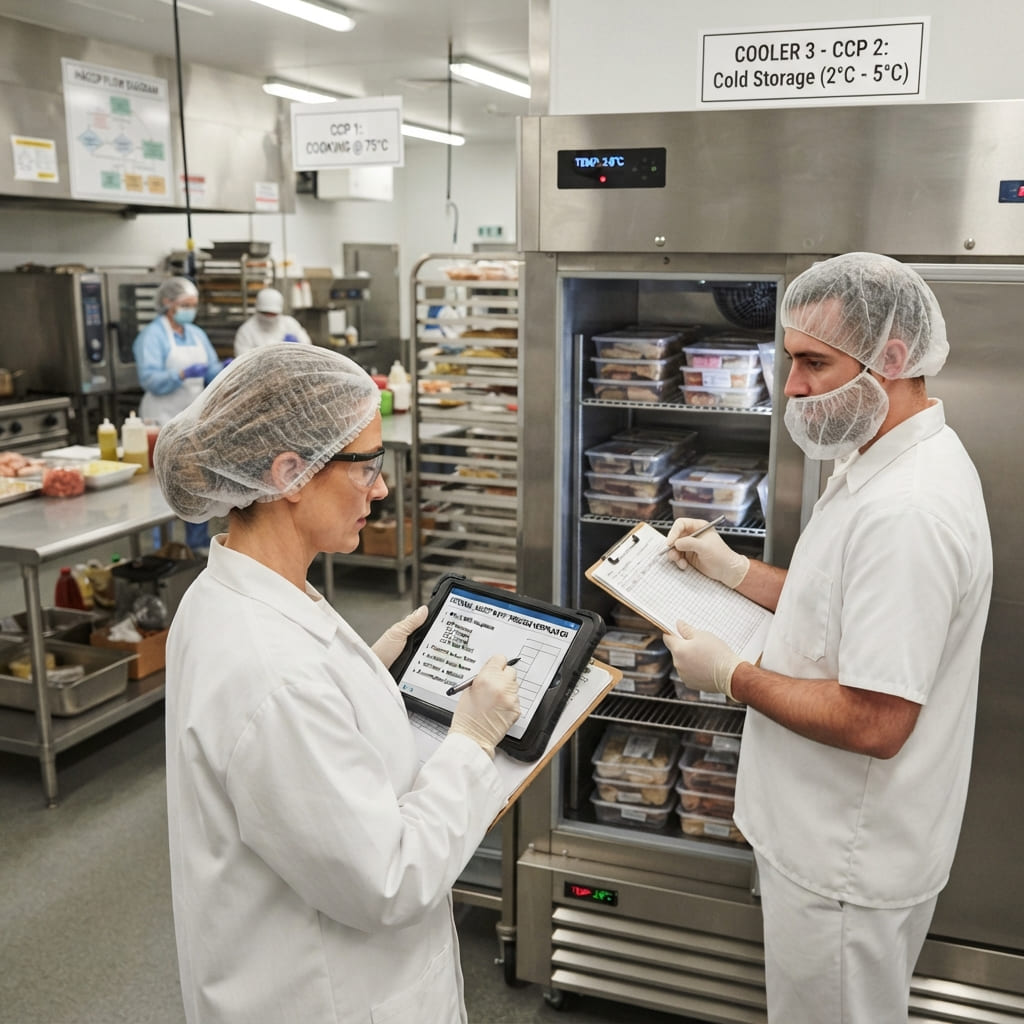
HACCP audits are an important way for food businesses to check whether their food safety procedures are being followed and whether their HACCP system remains effective. A well-planned internal audit can identify gaps before they develop into more serious food safety problems.
Restaurants, cafés, takeaways, catering businesses, bakeries, food retailers and food manufacturers in Ireland can use internal HACCP audits to review their procedures, records and day-to-day practices.
An internal audit is more than checking whether paperwork has been completed. It should examine whether the HACCP system actually reflects what happens in the business.
For managers and employees responsible for food safety, understanding how audits work is an important part of HACCP training Ireland.
What Is a HACCP Audit?
A HACCP audit is a systematic review of a food business's HACCP system and its implementation.
An internal HACCP audit can examine:
- HACCP procedures
- Food handling practices
- Prerequisite programmes
- Critical Control Points
- Monitoring records
- Corrective actions
- Staff training
- Cleaning
- Storage
- Equipment
- Verification activities
The purpose is to determine whether the system is being followed and whether it continues to be appropriate for the business.
Why Are Internal HACCP Audits Important?
A HACCP system can look correct on paper while problems exist in everyday operations.
For example, a cleaning procedure may state that equipment must be cleaned at a particular frequency, but an audit may discover that employees are not following the schedule.
Similarly, temperature monitoring records may be completed correctly, while the actual storage conditions do not match the documented procedures.
Internal audits help identify these differences.
They provide an opportunity to ask:
Does our documented HACCP system match what actually happens?
What Should an Internal HACCP Audit Check?
The scope of an internal audit should reflect the business.
However, a typical HACCP audit may review:
- HACCP documentation
- Hazard analysis
- Flow diagrams
- Prerequisite programmes
- Critical Control Points
- Critical limits
- Monitoring
- Corrective actions
- Verification
- Staff training
- Records
- Premises and equipment
Each area can reveal different weaknesses.
1. Review the HACCP Documentation
The first step may be reviewing the HACCP documentation.
Ask:
- Is the HACCP plan current?
- Does it describe the actual business?
- Are products and processes accurately represented?
- Are responsibilities clearly assigned?
- Are procedures available to relevant employees?
A HACCP document should not simply remain unchanged for years.
It should reflect significant changes to the food operation.
2. Check the HACCP Flow Diagram
The flow diagram should accurately represent the food process.
During an audit, compare the documented flow diagram with what employees actually do.
Check whether it includes relevant stages such as:
- Receiving
- Storage
- Preparation
- Cooking
- Cooling
- Reheating
- Packaging
- Transportation
- Service
Where alternative routes exist, they should also be considered.
An inaccurate flow diagram can affect the entire hazard analysis.
3. Review Hazard Analysis
The audit should consider whether relevant hazards have been identified.
Check whether the business has considered:
- Biological hazards
- Chemical hazards
- Physical hazards
- Allergens
- Cross-contamination
The hazard analysis should reflect the actual products and processes.
If the business has introduced new ingredients or preparation methods, the HACCP analysis may need to be reviewed.
4. Check Prerequisite Programmes
Prerequisite programmes provide the foundation for food safety.
An internal audit may review:
- Personal hygiene
- Cleaning and sanitation
- Pest control
- Waste management
- Maintenance
- Supplier controls
- Storage
- Staff training
The auditor should check both the procedures and their implementation.
For example, it is not enough to confirm that a cleaning schedule exists.
The auditor should also check whether cleaning is actually being performed as required.
5. Review Critical Control Points
Where the HACCP system identifies CCPs, the audit should check whether they remain appropriate.
Ask:
- Are CCPs clearly identified?
- Are employees aware of them?
- Are the controls being followed?
- Are critical limits clearly defined?
- Is monitoring taking place?
- Are deviations being managed?
Changes to processes may affect whether a CCP remains appropriate.
6. Check Critical Limits
Critical limits provide boundaries for acceptable and unacceptable conditions at CCPs.
During an audit, check:
- Are critical limits documented?
- Are they based on appropriate evidence?
- Are employees aware of them?
- Can they be measured?
- Are monitoring results compared with the limits?
- Are deviations acted upon?
A critical limit is only useful if employees understand how to monitor it and what to do when it is exceeded.
7. Review Monitoring Procedures
Monitoring is essential for determining whether HACCP controls are operating as intended.
An audit should examine:
- What is monitored?
- How is it monitored?
- How frequently?
- Who performs the checks?
- Are results recorded?
- Are records complete?
- Are abnormal results followed up?
The auditor should compare records with actual practices.
8. Check HACCP Records
Records provide evidence that procedures have been implemented.
Depending on the business, records may include:
- Temperature records
- Cleaning records
- Receiving checks
- Corrective action records
- Pest control records
- Maintenance records
- Training records
- Verification records
The auditor should check whether records are:
- Complete
- Accurate
- Legible
- Current
- Consistent with actual operations
Missing or inconsistent records may indicate a problem with implementation.
9. Review Corrective Actions
An internal audit should check how the business responds when something goes wrong.
Review previous corrective actions and ask:
- Were deviations identified?
- Was affected food managed appropriately?
- Was the process restored to control?
- Was the incident recorded?
- Was the cause investigated?
- Was follow-up completed?
Repeated deviations may indicate that the underlying problem has not been properly addressed.
10. Check Verification Activities
Verification is used to determine whether the HACCP system is working as intended.
An audit may review:
- Internal checks
- Record reviews
- Equipment checks
- Observations
- Testing where applicable
- Previous audit findings
Verification should provide meaningful information rather than simply generate paperwork.
11. Observe Employee Practices
One of the most valuable parts of an internal HACCP audit is observing employees during normal operations.
Look at:
- Hand hygiene
- Use of protective clothing
- Food handling
- Separation of raw and ready-to-eat foods
- Cleaning
- Temperature monitoring
- Allergen controls
- Storage practices
Employees may follow procedures differently when they are working under normal conditions than when they are completing paperwork.
Observation can therefore reveal practical issues that records do not show.
12. Check Food Storage
Storage conditions should also be reviewed.
An audit can examine:
- Refrigerated storage
- Frozen storage
- Dry storage
- Food separation
- Labelling
- Stock rotation
- Packaging
- Allergen segregation
The objective is to determine whether food is protected from contamination and stored under appropriate conditions.
13. Check Cleaning and Hygiene
The auditor should inspect food-contact surfaces, equipment and work areas.
Consider:
- Are surfaces visibly clean?
- Are cleaning procedures being followed?
- Are appropriate cleaning products used?
- Are cleaning tools maintained?
- Are cleaning records accurate?
- Are difficult-to-clean areas being addressed?
The audit should focus on whether the cleaning system is effective rather than simply whether a schedule exists.
14. Review Allergen Controls
For businesses handling allergens, an audit should examine how allergen risks are controlled.
Check:
- Ingredient information
- Allergen communication
- Storage
- Cleaning
- Cross-contact prevention
- Staff knowledge
- Labelling where applicable
Employees should know where reliable allergen information is located and should understand the procedures relevant to their roles.
15. Check Equipment and Maintenance
Equipment can affect food safety.
An audit should examine whether:
- Equipment is functioning correctly.
- Food-contact surfaces are in good condition.
- Refrigeration equipment is operating appropriately.
- Measuring equipment is suitable.
- Maintenance problems are reported.
- Repairs are completed.
Damaged equipment may create biological, chemical or physical contamination risks.
HACCP Audits and Staff Training
Employees are an important part of any HACCP system.
An internal audit should consider whether staff have received appropriate training and whether they understand the procedures they are expected to follow.
Questions may include:
- Do employees understand basic HACCP principles?
- Do they know the food safety hazards relevant to their work?
- Do they understand CCPs?
- Do they know what to do when a critical limit is exceeded?
- Do they understand allergen procedures?
- Do they know how to report problems?
This is where HACCP training Ireland can be particularly relevant.
HACCP Level 1 and Level 2 Training
Different roles may require different levels of HACCP knowledge.
HACCP Level 1 training may introduce:
- Food safety hazards
- Food hygiene
- Basic HACCP principles
- Food handler responsibilities
HACCP Level 2 training may cover more detailed topics such as:
- Hazard analysis
- Flow diagrams
- Critical Control Points
- Critical limits
- Monitoring
- Corrective actions
- Verification
- Documentation
- Internal HACCP procedures
If you are looking for a HACCP Level 2 certificate, check the course content to ensure it is appropriate for your responsibilities.
HACCP Certificate Ireland
People searching for a HACCP certificate Ireland may find courses advertised as:
- HACCP course Ireland
- HACCP training Ireland
- HACCP certification Ireland
- HACCP certification course
- HACCP training certificate
- HACCP Level 2 certificate
- HACCP food safety training
When choosing training, consider your actual job responsibilities and the level of HACCP knowledge required.
A food handler may have different training needs from someone who manages or audits a HACCP system.
Online HACCP Training
Online HACCP training can provide a flexible way for employees and managers to learn about HACCP principles.
An online HACCP course Ireland may cover:
- Food safety hazards
- Hazard analysis
- CCPs
- Critical limits
- Monitoring
- Corrective actions
- Verification
- HACCP documentation
Online learning can be convenient for people who need flexible study arrangements.
However, workplace procedures should still be explained and implemented within the individual food business.
How Often Should HACCP Audits Be Conducted?
The appropriate frequency depends on the business.
Factors that may influence the audit schedule include:
- Size of the business
- Complexity of food processes
- Type of food
- Previous audit findings
- Changes to processes
- Food safety incidents
- Level of risk
A business may establish a planned internal audit schedule and conduct additional checks when significant problems occur.
What to Do After an Audit
An audit should result in useful actions.
The business should:
- Record findings.
- Identify non-conformities.
- Determine their significance.
- Assign responsibility.
- Establish appropriate corrective actions.
- Set reasonable completion dates.
- Verify that actions have been completed.
- Review recurring issues.
The objective is improvement rather than simply completing an audit form.
Common Internal HACCP Audit Mistakes
Food businesses should avoid:
Auditing Only Paperwork
Actual working practices need to be observed.
Using the Same Checklist Without Thinking
The audit should reflect the business and its current risks.
Ignoring Small Problems
Minor failures can become significant if they repeatedly occur.
Failing to Follow Up
Findings should result in appropriate action.
Treating an Audit as a Blame Exercise
The goal is to identify weaknesses and improve food safety.
Not Updating the HACCP System
Significant changes should trigger a review.
Practical HACCP Audit Checklist
An internal auditor can ask:
- Is the HACCP plan current?
- Does the flow diagram match actual operations?
- Are hazards correctly identified?
- Are prerequisite programmes effective?
- Are CCPs clearly identified?
- Are critical limits appropriate?
- Is monitoring being completed?
- Are records accurate?
- Are corrective actions effective?
- Is verification being performed?
- Are employees appropriately trained?
- Are cleaning procedures effective?
- Are storage conditions appropriate?
- Are allergen controls effective?
- Is equipment maintained?
- Have previous audit findings been addressed?
Final Thoughts
HACCP audits give food businesses an opportunity to check whether their food safety management system is actually working in practice.
A useful internal audit should examine more than paperwork. It should consider:
- HACCP documentation
- Flow diagrams
- Hazard analysis
- Prerequisite programmes
- CCPs
- Critical limits
- Monitoring
- Corrective actions
- Verification
- Employee practices
- Training
- Food storage
- Cleaning
- Allergen controls
- Equipment
For food businesses in Ireland, appropriate HACCP training Ireland can help employees and managers understand the principles behind HACCP audits and food safety management.
If you are looking for a HACCP course Ireland, HACCP certificate Ireland, HACCP certification course, HACCP Level 2 training, HACCP training certificate or online HACCP training, consider whether the course content matches the responsibilities of the learner.
An effective internal HACCP audit should ultimately answer one important question:
Is the food safety system we have designed actually being followed and working as intended?
By regularly reviewing procedures, observing real working practices, examining records and addressing problems, food businesses can identify weaknesses early and continually improve their food safety management system.