



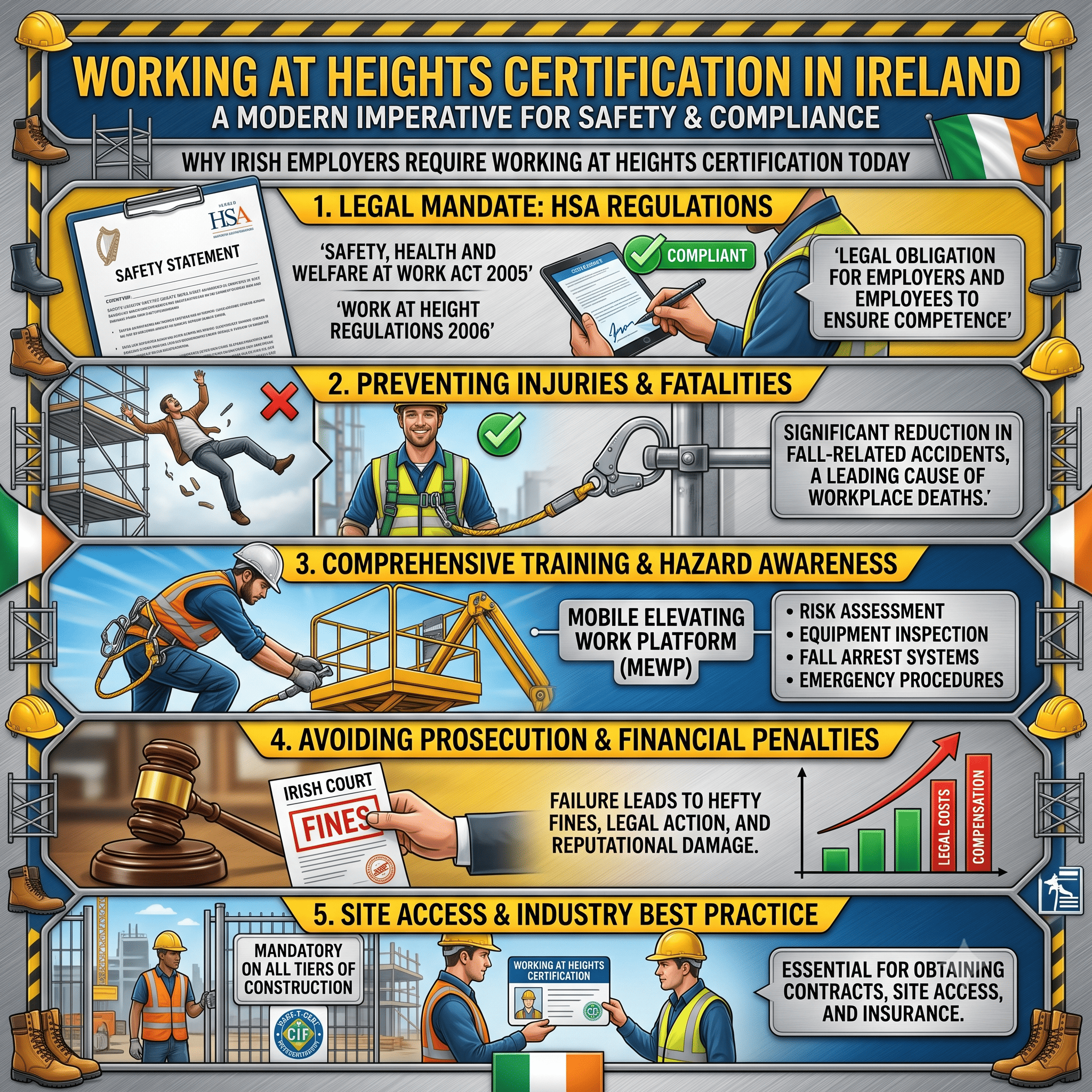
Workplace safety has become one of the highest priorities for businesses across Ireland. Employers are expected to provide safe working environments, minimise workplace risks, and ensure employees have the knowledge and skills needed to perform their duties safely. For businesses where employees work above ground level, Working at Heights Certification has become an essential requirement.
From construction sites and warehouses to maintenance, telecommunications, roofing, and manufacturing, many industries involve tasks where there is a risk of falling. These activities can lead to serious injuries if workers are not properly trained. This is why more employers now require staff to complete working at heights training in Ireland before carrying out elevated work.
A recognised working at heights certificate demonstrates that a worker understands the principles of safe working practices, hazard identification, and fall prevention. It also helps employers meet their legal responsibilities and build a stronger safety culture.
This guide explains why Irish employers increasingly require working at heights certification, what the training includes, and how it benefits both businesses and employees.
What Is Working at Heights Certification?
A Working at Heights Certificate confirms that an individual has successfully completed training focused on working safely where there is a risk of falling.
The course is designed to teach workers how to:
- Recognise workplace hazards
- Carry out basic risk assessments
- Use ladders safely
- Understand scaffolding safety
- Use personal protective equipment (PPE)
- Follow safe work procedures
- Respond appropriately during emergencies
Many employers also choose working at heights online training in Ireland, allowing employees to complete training remotely while still gaining the necessary knowledge.
Why Working at Heights Is a Major Workplace Risk
Working at height does not only involve tall buildings or cranes. Employees may be working at height whenever there is a possibility of falling and suffering injury.
Examples include:
- Using ladders
- Working on roofs
- Installing solar panels
- Carrying out electrical work
- Warehouse stock retrieval
- Building maintenance
- Window installation
- Operating elevated work platforms
Even a fall from a relatively low height can result in serious injuries.
Because of these risks, employers place significant importance on proper safety training.
Legal Responsibilities of Irish Employers
Irish employers have legal obligations under workplace safety legislation to protect employees from harm.
The Safety, Health and Welfare at Work Act 2005 requires employers to:
- Provide a safe workplace
- Assess workplace risks
- Provide suitable information and instruction
- Ensure employees receive appropriate training
- Maintain safe systems of work
For workplaces involving elevated tasks, providing working at heights training in Ireland is an important way to fulfil these responsibilities.
Compliance With Work at Height Regulations
Employers must also comply with regulations relating specifically to work at height.
These regulations require businesses to:
- Avoid work at height where possible
- Plan elevated work carefully
- Use appropriate equipment
- Prevent falls where reasonably practicable
- Reduce the consequences of falls
- Ensure workers are competent
Training is one of the most effective ways of demonstrating worker competence.
Why Employers Require Certification
There are several reasons why businesses increasingly expect employees to hold a working at heights certificate online or classroom qualification.
1. To Improve Workplace Safety
The primary reason is protecting workers.
Training helps employees:
- Recognise hazards
- Avoid unsafe practices
- Follow safe procedures
- Make better decisions
- Reduce accident risks
Well-trained workers are generally more aware of the dangers associated with elevated work.
2. To Meet Legal Requirements
Providing appropriate safety training helps employers demonstrate compliance with Irish legislation.
Maintaining records of completed health and safety courses in Ireland also supports workplace inspections and internal safety management.
3. To Reduce Workplace Accidents
Many workplace falls result from avoidable mistakes such as:
- Incorrect ladder positioning
- Failure to inspect equipment
- Poor planning
- Ignoring weather conditions
- Not wearing PPE
- Unsafe shortcuts
Training addresses these issues directly.
4. To Protect Employees
Employees are an organisation's most valuable resource.
Investing in working at heights training in Ireland helps reduce the likelihood of serious injuries that could affect workers and their families.
5. To Improve Productivity
Workers who understand safe working procedures often complete tasks more efficiently.
Less time is spent dealing with:
- Accidents
- Equipment misuse
- Project delays
- Workplace investigations
A safer workplace often leads to smoother operations.
6. To Support Insurance and Risk Management
Although insurance requirements vary between organisations and policies, businesses generally benefit from demonstrating that they have taken reasonable steps to manage workplace risks through training, supervision, and safe systems of work.
Maintaining up-to-date training records can form part of a broader risk management strategy.
7. To Strengthen Company Reputation
Businesses known for maintaining high safety standards often build stronger relationships with:
- Clients
- Contractors
- Employees
- Business partners
A commitment to safety reflects professionalism and responsible management.
What Workers Learn During Certification
A professional working at heights training course in Ireland covers practical safety knowledge that employees can apply immediately.
Hazard Identification
Workers learn how to recognise:
- Open edges
- Fragile roofs
- Slippery surfaces
- Falling object risks
- Unsafe access routes
- Poor weather conditions
Early hazard recognition helps prevent accidents.
Risk Assessment
Training explains how to:
- Examine work areas
- Identify hazards
- Assess risks
- Select suitable controls
- Plan safe working methods
Risk assessment is one of the most important workplace safety skills.
Ladder Safety
Workers receive instruction on:
- Ladder selection
- Equipment inspection
- Safe positioning
- Correct climbing techniques
- Preventing overreaching
Scaffolding Awareness
Training covers:
- Safe access
- Platform inspections
- Guardrail systems
- Identifying unsafe scaffolding
Personal Protective Equipment (PPE)
Employees learn how to use:
- Safety harnesses
- Lanyards
- Anchor points
- Helmets
- Fall arrest systems
Workers also learn how to inspect PPE before each use.
Emergency Procedures
Training includes:
- Rescue planning
- Incident reporting
- Emergency communication
- Evacuation procedures
Understanding emergency procedures improves preparedness if an incident occurs.
Benefits for Employees
Holding a working at heights certificate provides several personal advantages.
These include:
- Increased confidence
- Improved workplace safety
- Better understanding of hazards
- Greater employability
- Demonstrated commitment to professional development
Many employers prefer candidates who already possess recognised safety training.
Benefits for Employers
Providing certification also offers important business benefits.
These include:
- Improved legal compliance
- Reduced workplace accidents
- Better workforce confidence
- Stronger safety culture
- Easier training management
- Improved operational efficiency
Investing in training supports both employee welfare and business performance.
Online Working at Heights Training
Many businesses now use health and safety courses online in Ireland because they offer flexibility and convenience.
Online training allows employees to:
- Learn at their own pace
- Access courses from multiple devices
- Complete training remotely
- Receive digital certificates
For employers, online learning makes it easier to train workers across different locations while reducing travel and scheduling challenges.
Choosing the Right Training Provider
When selecting health and safety courses online in Ireland, employers should consider:
- Course quality
- Recognition within industry
- Practical workplace content
- Alignment with Irish legislation
- Ease of learner access
- Customer support
A reputable provider delivers training that is both informative and relevant to real workplace situations.
Creating a Safer Workplace
Certification is only one part of workplace safety.
Employers should also:
- Carry out regular risk assessments
- Inspect equipment
- Maintain safe systems of work
- Encourage hazard reporting
- Provide refresher training
- Promote continuous improvement
When certification is combined with strong safety management, organisations can significantly reduce workplace risks.
Final Thoughts
Why Irish Employers Require Working at Heights Certification Today demonstrates why certification has become a standard requirement across many industries. As workplace safety expectations continue to grow, employers recognise that proper training is one of the most effective ways to protect employees, meet legal responsibilities, and reduce the likelihood of serious accidents.
Completing working at heights training in Ireland equips workers with essential skills in hazard identification, risk assessment, safe equipment use, and emergency procedures. Employers benefit through improved compliance, stronger safety performance, and a more confident workforce.
Whether delivered in person or through health and safety courses online in Ireland, working at heights certification represents an investment in safer workplaces, responsible business practices, and the long-term wellbeing of employees across Ireland.