



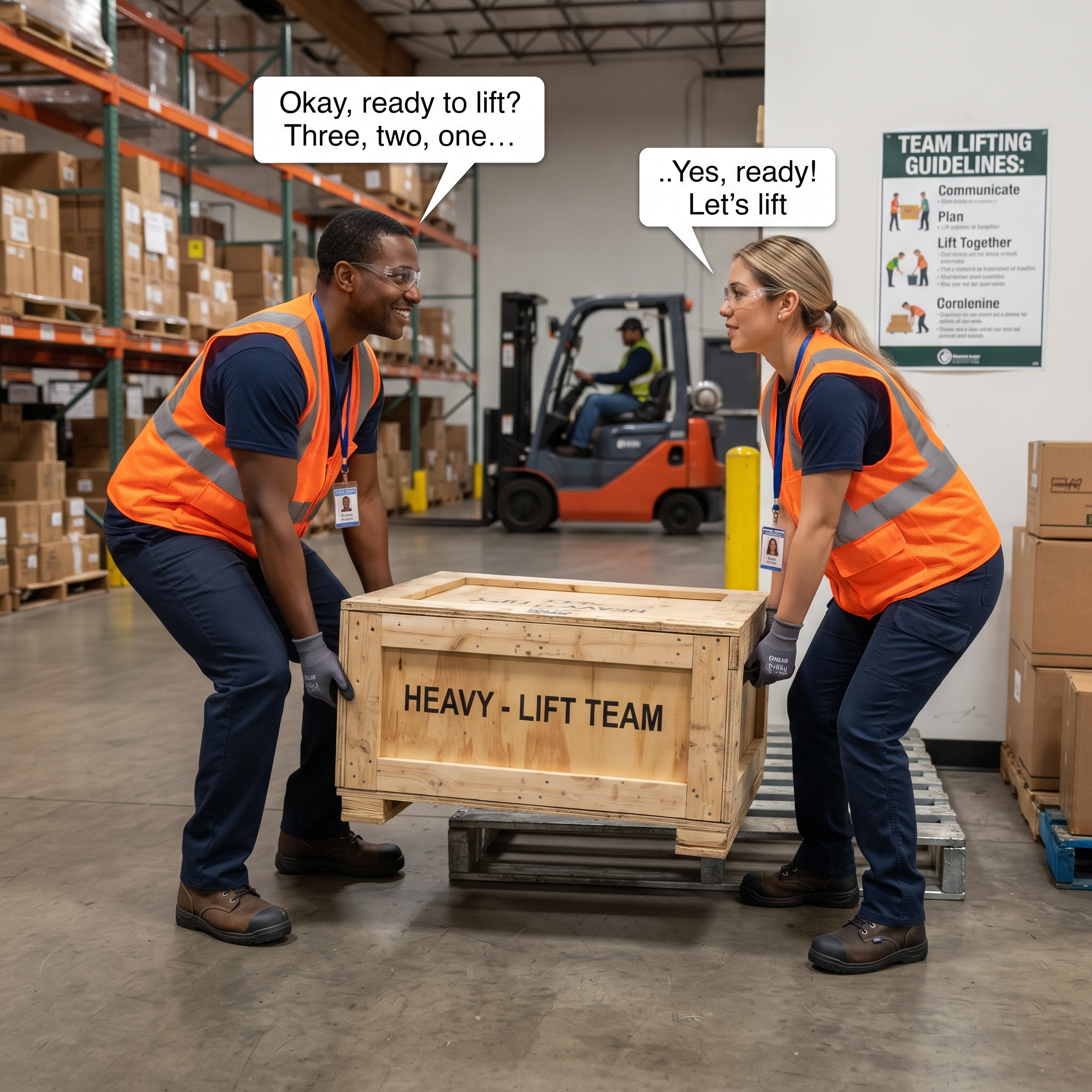
Team manual handling can be an effective way to move large, heavy or awkward loads that may be difficult for one person to handle safely. Across Ireland, employees in construction, warehousing, manufacturing, healthcare, retail, logistics and other industries may sometimes need to work together to move equipment, materials, stock or other workplace items.
However, involving several employees in a manual handling task does not automatically make the task safer.
When two or more people move a load together, everyone needs to understand what is happening. If one employee starts moving before the others are ready, changes direction without warning or releases the load unexpectedly, the entire team can be affected.
This is why communication during team manual handling is so important.
Professional Manual Handling Training Ireland can help employees understand the principles of safe lifting, carrying, pushing, pulling and team handling. A suitable Manual Handling Course Ireland can also teach workers how to assess loads, plan movements and recognise when a task requires assistance or mechanical equipment.
Good communication should be treated as an essential part of the handling plan rather than something that happens only when a problem occurs.
What Is Team Manual Handling?
Team manual handling occurs when two or more employees work together to move a load.
It may be necessary when an object is:
- Too large for one person.
- Difficult to grip.
- Awkwardly shaped.
- Long or bulky.
- Difficult to control.
- Too heavy for one employee to move safely.
Examples can include:
- Moving furniture.
- Carrying long materials.
- Repositioning equipment.
- Moving large containers.
- Handling machinery components.
- Transporting awkward stock.
The exact handling method should depend on the task and the characteristics of the load.
Why Communication Matters
When one person moves a load, they control their own movements.
During team handling, several people need to coordinate their movements.
Everyone needs to know:
- When the movement will begin.
- Which direction the load will travel.
- When to stop.
- Where the load will be placed.
- What to do if something goes wrong.
Without clear communication, employees can move at different speeds or in different directions.
This can make the load harder to control.
Plan Before You Lift
The first communication should take place before anyone touches the load.
The team should discuss the task.
Ask:
- What are we moving?
- How heavy is it?
- Is it stable?
- Where are we taking it?
- What route will we use?
- Are there obstacles?
- Who will lead?
- Where will everyone stand?
This short discussion can prevent confusion during the actual movement.
Choose a Team Leader
For many team-handling tasks, it is useful for one person to coordinate the movement.
The leader can give clear instructions such as:
"Ready."
"Lift."
"Move."
"Stop."
"Lower."
The exact words are less important than ensuring everyone understands them before the task begins.
Having one person coordinate the movement reduces the chance of several employees giving different instructions at the same time.
Agree on Commands in Advance
Before starting, the team should agree on the commands they will use.
For example:
"Ready"
Everyone gets into position.
"Lift"
The team raises the load together.
"Move"
The team begins travelling.
"Stop"
Everyone stops immediately.
"Lower"
The load is lowered together.
Simple commands can be particularly useful when employees cannot easily see one another.
Make Sure Everyone Can Hear
Communication is only useful if everyone can hear it.
Noise can be a significant issue in environments such as:
- Construction sites.
- Warehouses.
- Factories.
- Workshops.
Employees may be unable to hear instructions over machinery, vehicles or other workplace activity.
Where verbal communication is difficult, the team should establish an alternative communication method before beginning the task.
Consider Visibility
Employees may not always be able to see one another during team handling.
A large load can block visibility.
One worker may also be positioned around a corner or on the opposite side of an object.
The team should establish how instructions will be communicated in advance.
If one employee cannot see the route, another worker may need to guide the movement.
Move at the Same Pace
One of the biggest benefits of good communication is coordinated movement.
Employees should avoid moving independently.
If one person moves faster than the others, the load can shift unexpectedly.
The team leader should communicate changes in direction and speed.
Workers should also stop if they lose control or if another employee is not ready.
Communicate Before Changing Direction
Changing direction can be particularly challenging when moving a large or awkward load.
The person leading the movement should communicate before turning.
For example:
"Turning left."
This gives the rest of the team time to prepare.
Unexpected movements can make loads harder to control.
Communicate When Obstacles Appear
Routes should ideally be checked before moving the load.
However, unexpected obstacles can still appear.
Employees should communicate immediately if:
- Someone enters the route.
- A door is closed.
- An object falls into the path.
- The surface becomes difficult.
- The load shifts.
The team should stop if necessary and reassess the situation.
Never Assume Everyone Is Ready
One employee may be ready to lift while another is still adjusting their position.
The person coordinating the task should ensure everyone is ready before giving the lifting command.
A simple "Ready?" can prevent an employee from being caught by surprise.
This is particularly important when loads are heavy or awkward.
Communication During Lowering
Lowering a load requires the same level of coordination as lifting it.
Employees should not lower the object independently.
The leader should clearly communicate when the team is going to lower the load.
Workers should maintain control until the load is securely placed.
What If Something Goes Wrong?
The team should agree beforehand on what to do if the load becomes difficult to control.
For example:
"Stop" should mean that everyone stops immediately.
Employees should not continue moving simply because they are already halfway through the task.
If the load becomes unstable, the safest option may be to lower it if this can be done safely and reassess the handling method.
Avoid Unnecessary Talking During the Movement
Communication is important, but instructions should remain clear.
Too much unrelated conversation can make important commands harder to hear.
During the movement, communication should focus on relevant information such as:
- Direction.
- Speed.
- Obstacles.
- Starting.
- Stopping.
- Lowering.
Clear and concise communication is usually most effective.
Team Handling Is Not Always the Best Solution
Adding more people does not necessarily make every manual handling task safer.
A load may still be difficult to control even with several employees.
The team may also have limited space or an unsuitable route.
Before deciding to use team handling, employers should consider whether mechanical equipment would be a safer alternative.
Examples include:
- Trolleys.
- Hoists.
- Pallet trucks.
- Lift tables.
- Other suitable handling equipment.
Assess the Load First
Before forming a team, employees should understand the characteristics of the load.
Consider:
- Weight.
- Size.
- Shape.
- Stability.
- Grip.
- Centre of gravity.
- Route.
An unevenly weighted load may require particularly careful positioning.
Employees should also understand where they need to stand before lifting.
Consider the Workplace Environment
The environment can affect communication and coordination.
Check for:
- Slippery floors.
- Uneven surfaces.
- Narrow routes.
- Poor lighting.
- Noise.
- Obstacles.
- Restricted access.
A team may communicate perfectly but still struggle if the environment is unsuitable.
Team Handling in Warehouses
Warehouses frequently involve team handling.
Employees may need to move:
- Large packages.
- Equipment.
- Palletised goods.
- Oversized stock.
Warehouse environments can also be noisy and busy.
Clear communication is particularly important when pedestrians, vehicles and handling equipment operate in the same area.
Team Handling in Construction
Construction workers may sometimes handle:
- Long materials.
- Building components.
- Equipment.
- Tools.
Construction sites can contain uneven surfaces, changing routes and multiple simultaneous activities.
Workers should agree on the movement before starting and communicate clearly throughout.
Team Handling in Healthcare
Healthcare employees may work together when moving equipment or assisting with certain patient-handling activities.
Patient handling is a specialised area and should follow appropriate workplace procedures, risk assessments and training.
Employees should never improvise a team-handling method when specific procedures apply.
Manual Handling Training Ireland
Professional Manual Handling Training Ireland can help employees understand how communication fits into safe team handling.
Training can cover:
- Risk assessment.
- Load assessment.
- Safe lifting.
- Carrying.
- Team handling.
- Pushing and pulling.
- Mechanical handling equipment.
- Hazard awareness.
Employees can then apply these principles when working with colleagues.
Manual Handling Course Ireland
A suitable Manual Handling Course Ireland should help workers understand that team handling requires planning.
Employees should know when to:
- Ask for assistance.
- Use equipment.
- Stop a task.
- Reassess a load.
- Communicate with colleagues.
Team handling should be treated as a coordinated activity rather than simply asking another person to "help lift."
Manual Handling Certificate Ireland
Employees who complete appropriate training may receive a Manual Handling Certificate Ireland.
A certificate provides evidence that relevant training has been completed.
However, certification does not automatically make every team-handling activity safe.
The task still needs to be assessed, and employees need to follow workplace procedures.
Common Communication Mistakes
Several communication problems can increase risk.
These include:
Starting Without a Plan
Employees begin lifting before discussing the movement.
Multiple People Giving Instructions
Different commands can cause confusion.
Not Confirming Readiness
One worker starts before everyone is positioned.
Failing to Communicate Obstacles
The team encounters an obstacle without warning.
Changing Direction Without Notice
The load moves unexpectedly.
Not Saying "Stop"
Employees continue even when someone is struggling.
Avoiding these mistakes can significantly improve team coordination.
How Employers Can Improve Communication
Employers can support better team handling by:
- Providing suitable training.
- Establishing clear procedures.
- Encouraging employees to communicate.
- Providing appropriate equipment.
- Reviewing high-risk tasks.
- Ensuring routes are suitable.
- Supervising new employees where necessary.
Workers should also be encouraged to stop a task if they believe it cannot be completed safely.
Practical Team Handling Checklist
Before moving a load together, ask:
1. Is team handling necessary?
Could mechanical equipment be used?
2. Is the load suitable for team handling?
Is it stable and controllable?
3. Is the route clear?
Are there obstacles or restricted areas?
4. Who will lead?
One person should coordinate the movement.
5. What commands will be used?
Agree before starting.
6. Is everyone ready?
Confirm before lifting.
7. What happens if something goes wrong?
Agree on the stop command.
This simple checklist can help employees prepare for team manual handling tasks.
Conclusion
Communication is one of the most important elements of safe team manual handling.
When two or more employees move a load together, they need to coordinate their movements from beginning to end. Everyone should understand the plan, know who is leading and agree on simple commands for lifting, moving, stopping and lowering.
Employers should also assess whether team handling is actually the most appropriate solution. Where possible, mechanical handling equipment may eliminate or reduce the physical demands of the task.
Professional Manual Handling Training Ireland can help employees understand how to assess loads, plan tasks and work safely as part of a team. A suitable Manual Handling Course Ireland can cover safe lifting, carrying, pushing, pulling, team handling and risk assessment.
A Manual Handling Certificate Ireland provides evidence of completed training, but effective team handling also depends on communication, cooperation and appropriate workplace controls.
By planning movements, using clear commands, listening to colleagues and stopping whenever conditions become unsafe, employees can work together more effectively and reduce unnecessary manual handling risks in Irish workplaces.