



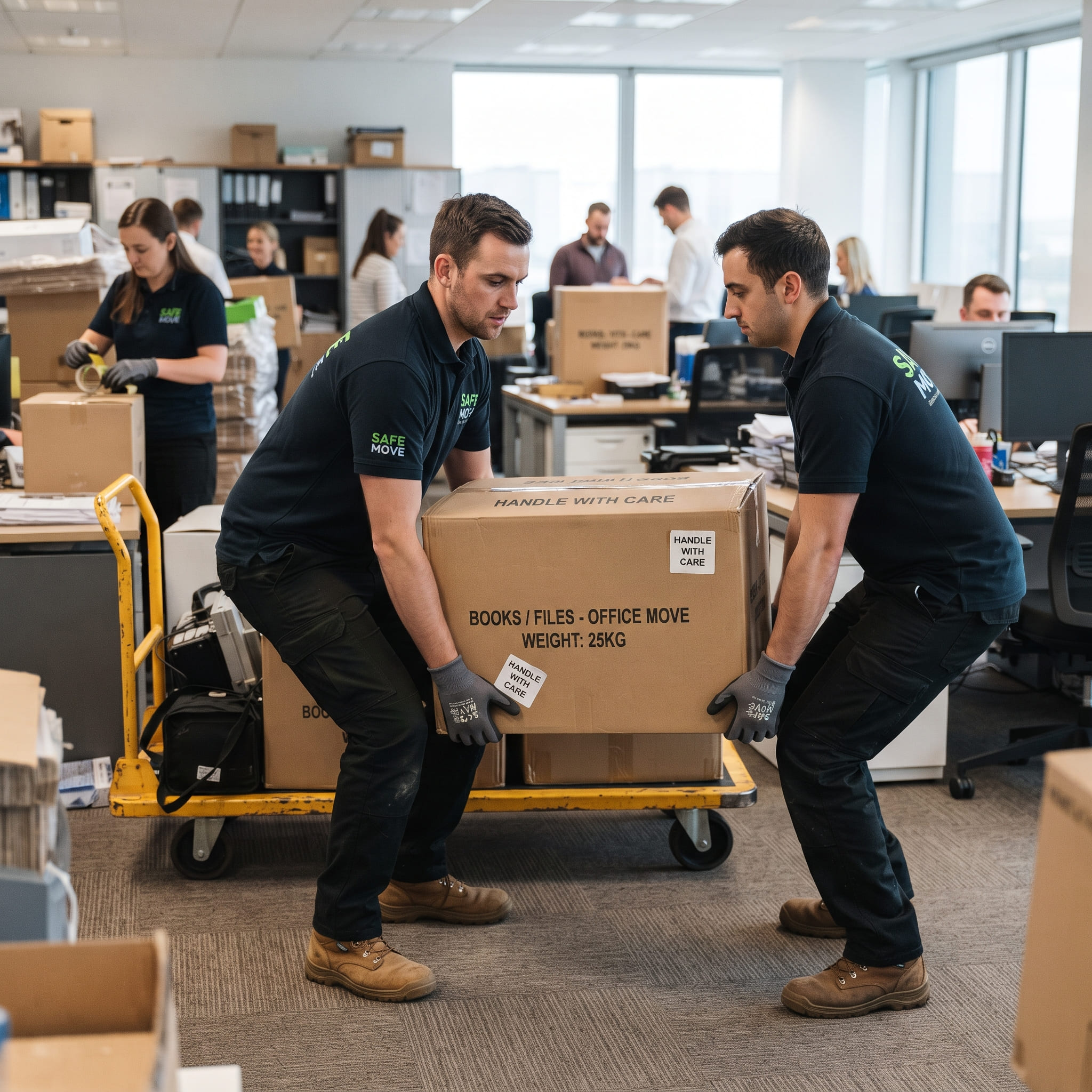
Workplace relocations and office moves can be exciting, but they can also create a temporary increase in manual handling risks. During a normal working day, employees may only move small quantities of equipment or supplies. During a relocation, however, they may suddenly be expected to pack boxes, move furniture, carry equipment, load vehicles and unpack items at a new location.
Desks, chairs, filing cabinets, computers, printers, boxes of documents and other office equipment can all require lifting, carrying, pushing or pulling.
Because office moves are often organised around a deadline, employees may feel pressure to work quickly. This can encourage rushing, carrying loads that are too heavy or awkward, taking unsuitable routes and attempting tasks without appropriate equipment.
Good planning can significantly reduce these risks.
Professional Manual Handling Training Ireland can help employees understand how to assess loads, plan movements, use safer techniques and recognise when assistance is required. A suitable Manual Handling Course Ireland can provide useful knowledge for employees who may be involved in workplace relocation activities.
However, training should be combined with proper planning, suitable equipment and appropriate workplace controls.
Why Office Moves Create Additional Manual Handling Risks
An office move can involve many different types of physical activity in a short period.
Employees may need to:
- Pack boxes.
- Move computers.
- Carry documents.
- Lift chairs.
- Push desks.
- Move cabinets.
- Load vehicles.
- Unload equipment.
- Rearrange furniture.
- Set up the new workplace.
Some of these activities may not normally form part of an employee's regular job.
This means that an office move can introduce manual handling tasks that employees are not accustomed to performing.
Plan the Move Before It Begins
One of the most effective ways to improve safety is to plan the relocation in advance.
Before moving anything, employers should consider:
- What needs to be moved?
- How heavy are the items?
- Which items are awkward?
- How many employees are required?
- What equipment is available?
- Which route will be used?
- Where will everything be placed at the new location?
Creating a clear plan can prevent employees from making decisions at the last minute.
Create an Inventory
An inventory can help identify which items require special attention.
Separate items into categories such as:
- Small boxes.
- Large boxes.
- Office furniture.
- Electronic equipment.
- Heavy equipment.
- Fragile items.
- Awkward objects.
This allows employers to identify higher-risk handling tasks before the move begins.
Do Not Assume Employees Should Move Everything
Employees should not automatically be expected to manually move every item in an office.
For heavy, bulky or awkward equipment, professional movers or suitable mechanical handling equipment may be more appropriate.
Employers should consider whether manual handling can be eliminated or reduced.
This is particularly important for large furniture and equipment.
Pack Boxes Carefully
Packing is itself a manual handling activity.
Boxes should not be filled simply because there is space available.
Overfilled boxes can become unnecessarily heavy and difficult to control.
Where possible:
- Use manageable box sizes.
- Avoid overfilling.
- Distribute weight appropriately.
- Close boxes securely.
- Label heavy boxes clearly.
Smaller, manageable loads can make moving safer and more organised.
Avoid Mixing Heavy and Light Items Incorrectly
A box filled entirely with heavy books or documents can become extremely difficult to move.
Instead, businesses can consider distributing heavier materials across several boxes.
Lighter materials can sometimes be placed alongside heavier items to make individual boxes easier to handle.
The objective should be to create loads that employees can control safely.
Label Heavy Boxes
Clear labelling can help employees identify heavier loads before attempting to lift them.
Labels can indicate:
- Heavy.
- Fragile.
- Electronic equipment.
- Handle with care.
- This side up.
Employees can then choose an appropriate handling method.
Prepare Routes in Advance
The route from the office to the removal vehicle and then into the new workplace should be checked before moving begins.
Look for:
- Stairs.
- Narrow doorways.
- Uneven surfaces.
- Wet floors.
- Obstacles.
- Tight corners.
- Heavy doors.
Employees carrying boxes may have limited visibility, so clear routes are particularly important.
Keep Walkways Clear
During a relocation, boxes can quickly accumulate.
Temporary piles of furniture and equipment can create additional hazards.
Walkways should be kept clear as far as reasonably practicable.
Boxes should not be left where they obstruct access routes or create trip hazards.
Use Trolleys and Moving Equipment
Trolleys can significantly reduce the amount of carrying required during an office move.
Depending on the task, suitable equipment may include:
- Platform trolleys.
- Sack trucks.
- Furniture-moving equipment.
- Carts.
- Lifting equipment.
Equipment should be appropriate for the load and used according to relevant procedures.
Move Furniture Carefully
Office furniture can be particularly awkward.
Examples include:
- Desks.
- Filing cabinets.
- Bookcases.
- Tables.
- Large chairs.
The size and shape of these objects can make them difficult to grip and manoeuvre through doorways.
Before moving furniture, employees should determine whether it needs to be dismantled.
Where appropriate, removing detachable components can make the individual pieces easier to manage.
Be Careful With Filing Cabinets
Filing cabinets can be deceptively heavy.
Before moving them, drawers and contents should be considered.
Removing documents and other contents can significantly reduce the load.
Employees should also consider whether a cabinet needs to be moved manually at all.
Moving Computers and Electronics
Computers and other electronic equipment may not be extremely heavy, but they can be awkward and fragile.
Employees should avoid carrying too much equipment at once.
Cables should be disconnected and organised before equipment is moved.
Carrying multiple items while trying to protect fragile equipment can increase the likelihood of dropping something.
Team Handling for Large Items
Some office equipment and furniture may require two or more people.
Before moving a large object, the team should agree on:
- Who will lead.
- Where everyone will stand.
- Which route will be used.
- When to lift.
- When to move.
- When to stop.
- Where the object will be placed.
Clear communication is particularly important when visibility is restricted.
Avoid Twisting While Carrying
Employees should avoid twisting their body unnecessarily while carrying loads.
This can be particularly difficult when moving around desks, doors and corners.
Workers should plan the route before lifting and position themselves appropriately.
If the route is too restricted, the task should be reassessed.
Do Not Carry Loads That Block Visibility
A large box may prevent an employee from seeing where they are walking.
This can increase the risk of:
- Trips.
- Collisions.
- Dropped loads.
- Falls.
If a load blocks visibility, employees should consider using a trolley, reducing the load size or asking for assistance.
Be Careful on Stairs
Stairs can create additional challenges during an office move.
Employees carrying boxes may have limited visibility and reduced ability to use handrails.
Where possible, suitable alternatives should be considered for moving heavy or bulky objects between floors.
Workers should not attempt to carry loads that make safe movement on stairs impossible.
Avoid Rushing
Office moves often have strict deadlines.
However, rushing can increase the likelihood of unsafe handling.
Employees may be tempted to:
- Carry multiple boxes.
- Skip equipment.
- Take shortcuts.
- Move furniture without assistance.
- Ignore obstacles.
Completing the move quickly should never take priority over safe working practices.
Consider Repetitive Handling
An office move can involve hundreds of similar movements.
Employees may spend hours:
- Packing boxes.
- Carrying boxes.
- Loading vehicles.
- Unloading vehicles.
- Rearranging equipment.
Even when individual loads are manageable, repetitive activity can increase physical demands.
Employers should organise the work appropriately and consider whether tasks can be shared or mechanical assistance introduced.
Plan Loading and Unloading
The manual handling risks do not end when items leave the office.
Loading vehicles and unloading at the new location also require careful planning.
Items should be positioned securely and handled using suitable equipment.
The unloading route should be prepared before work begins.
Consider the New Workplace Layout
The new office should ideally be prepared before employees start moving furniture and equipment.
Employees should know:
- Where desks are going.
- Where equipment belongs.
- Where boxes should be placed.
- Which areas are accessible.
This prevents unnecessary movement after the items arrive.
Reduce Double Handling
Poor planning can result in items being moved multiple times.
For example:
Office → vehicle → temporary storage → corridor → final room
Each additional movement creates another handling task.
Where practical, items should be taken directly to their intended location.
This can improve efficiency while reducing unnecessary physical work.
Manual Handling Training Ireland
Professional Manual Handling Training Ireland can help employees understand the principles required to move workplace items safely.
Training can cover:
- Risk assessment.
- Load assessment.
- Safe lifting.
- Carrying.
- Pushing and pulling.
- Team handling.
- Mechanical aids.
- Hazard awareness.
This knowledge can be particularly useful when employees are temporarily involved in relocation activities.
Manual Handling Course Ireland
A suitable Manual Handling Course Ireland can help employees understand that safe handling begins before lifting.
Workers should consider:
What am I moving?
How heavy or awkward is it?
Where is it going?
Is the route clear?
Do I need help?
Can equipment make this easier?
These questions encourage employees to plan rather than react.
Manual Handling Certificate Ireland
Employees who complete appropriate training may receive a Manual Handling Certificate Ireland.
A certificate provides evidence that relevant manual handling training has been completed.
However, having a certificate does not mean every office-moving task can safely be completed manually.
Employers should still assess the specific activities involved and provide suitable equipment and procedures.
What Employers Should Do Before an Office Move
A practical preparation checklist can include:
Before the move
- Create an inventory.
- Identify heavy and awkward items.
- Plan routes.
- Provide suitable boxes.
- Arrange handling equipment.
- Organise staffing.
- Identify items requiring specialist movers.
During the move
- Keep routes clear.
- Use appropriate equipment.
- Communicate during team handling.
- Avoid rushing.
- Stop if conditions become unsafe.
After the move
- Place items in planned locations.
- Remove packaging.
- Keep access routes clear.
- Check equipment and furniture.
- Review any problems encountered.
What Employees Should Remember
Employees involved in a workplace relocation should:
- Think before lifting.
- Assess the load.
- Plan the route.
- Use available equipment.
- Ask for assistance.
- Avoid carrying loads that block visibility.
- Communicate with colleagues.
- Avoid unnecessary twisting.
- Report unsafe conditions.
- Stop if a task cannot be completed safely.
Conclusion
Workplace relocations can create a temporary increase in manual handling activities. Employees may suddenly find themselves lifting boxes, carrying equipment, moving furniture, loading vehicles and rearranging an entire workplace.
Without proper planning, these activities can lead to unnecessary physical strain and increase the likelihood of accidents.
The safest approach is to plan the move before it begins. Employers should identify heavy and awkward items, organise suitable equipment, prepare routes, control repetitive tasks and determine which activities should be handled by specialist movers.
Employees should assess each load, use appropriate handling aids, communicate with colleagues and avoid rushing simply to meet a deadline.
Professional Manual Handling Training Ireland can give employees important knowledge about safe lifting, carrying, pushing, pulling, team handling and risk assessment. A suitable Manual Handling Course Ireland can help workers apply these principles when handling office equipment and other workplace items.
A Manual Handling Certificate Ireland demonstrates that relevant training has been completed, but effective safety depends on combining training with appropriate workplace planning and controls.
By preparing properly and treating an office move as a structured workplace activity rather than an informal task, businesses can reduce unnecessary manual handling risks and make workplace relocation safer, more organised and more efficient.