



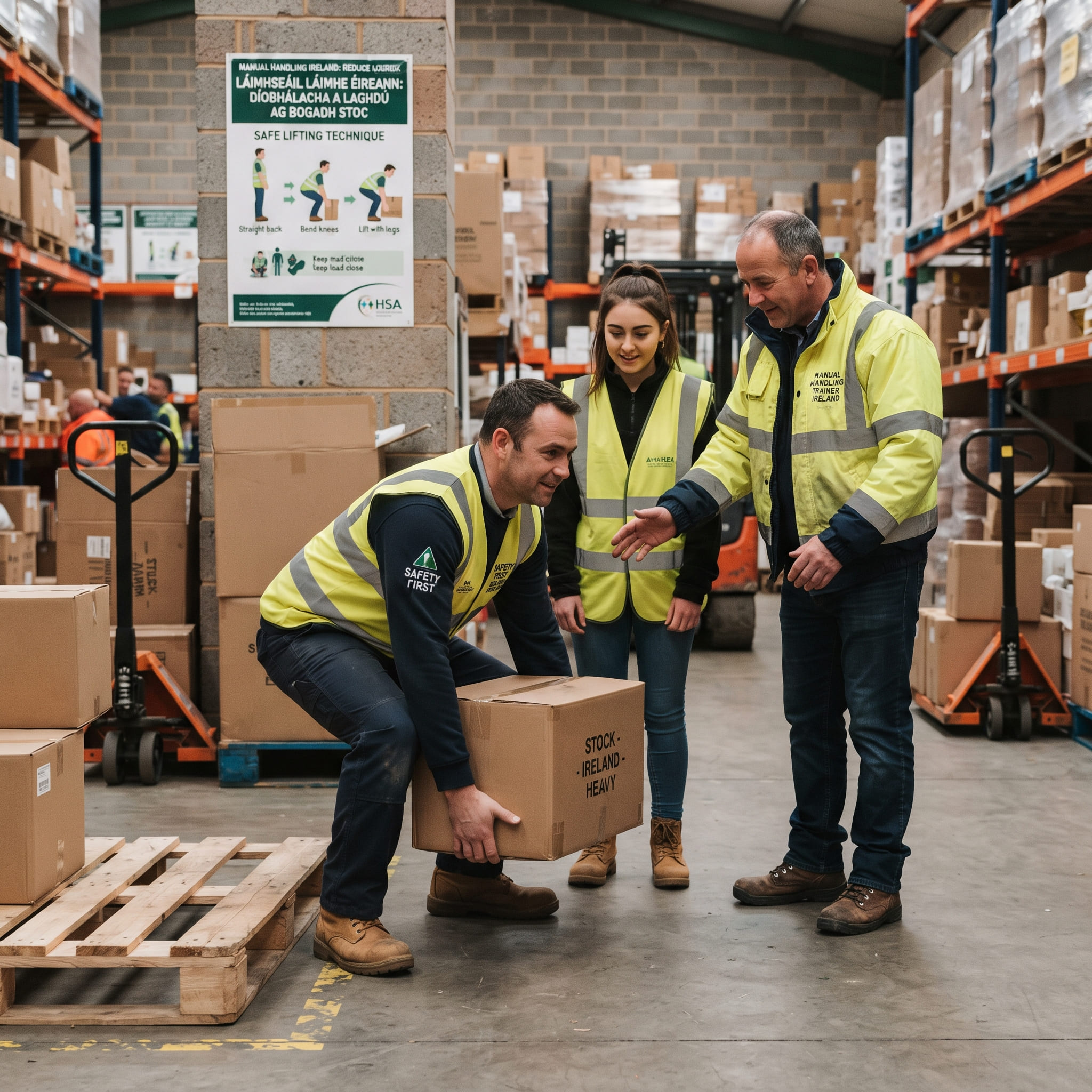
Moving stock is a routine activity in many workplaces across Ireland. Retail stores, warehouses, supermarkets, manufacturing facilities, hospitality businesses and distribution centres may require employees to move products and materials throughout the working day.
Stock can arrive in boxes, containers, pallets or individual items. Employees may need to unload deliveries, move products into storage, restock shelves, transfer materials between workstations or prepare orders for customers.
While these tasks may seem straightforward, repeated stock handling can place considerable physical demands on employees. Heavy loads, awkward boxes, repetitive movements, poor storage arrangements and long carrying distances can all increase manual handling risks.
The Health and Safety Authority (HSA) identifies factors such as force, awkward posture, repetition and workplace conditions as important considerations when assessing manual handling risks. Employers are expected to manage these risks and, where possible, avoid the need for manual handling through appropriate mechanical means.
This is where effective Manual Handling Training Ireland can make a valuable contribution. Training can help employees understand how to assess loads, plan movements, use appropriate techniques and recognise when assistance or equipment is required.
However, training should be part of a wider approach to risk reduction. The HSA's guidance specifically highlights measures such as handling aids, improved housekeeping, better organisation of work processes and reducing the amount of stock that needs to be manually handled.
Here are practical ways employers and employees can reduce injuries when moving stock.
1. Assess Stock Before Moving It
Before lifting or carrying stock, employees should consider the characteristics of the load.
Ask:
- How heavy is it?
- Is it bulky?
- Is it stable?
- Is it easy to grip?
- Is the weight evenly distributed?
- Can I see where I am going while carrying it?
A relatively light item can still be difficult to handle if it is large, awkward or unstable.
Employees should avoid assuming that every box or container can be safely handled in the same way.
2. Plan the Movement Before Lifting
Planning should take place before the load leaves the shelf, pallet or delivery area.
Consider:
Where is the stock going?
What route will I use?
Are there obstacles?
Do I need assistance?
Can I use a trolley or other handling aid?
Where will the stock be placed?
Planning helps prevent employees from making decisions while carrying a load.
It can also reduce unnecessary carrying and repeated handling.
3. Reduce Unnecessary Manual Handling
One of the most effective ways to reduce injuries is to reduce the amount of manual handling employees have to perform.
Employers should examine whether stock can be:
- Moved mechanically.
- Delivered closer to its final location.
- Stored more efficiently.
- Divided into smaller quantities.
- Transported using suitable handling equipment.
The HSA states that employers should take appropriate measures, particularly mechanical means, to avoid the need for manual handling where possible.
4. Use Trolleys and Handling Aids
Trolleys can make a significant difference when moving stock.
They can reduce the need to repeatedly carry individual items and can be particularly useful when products need to be transported over longer distances.
Before using a trolley, employees should check that:
- It is suitable for the load.
- The wheels are in good condition.
- The load is stable.
- The trolley is not overloaded.
- The route is clear.
Handling equipment should be used according to workplace procedures.
5. Avoid Overloading Boxes and Containers
Where stock is manually handled, employers should consider whether packaging can be divided into smaller units.
Overloaded containers can make lifting more difficult and increase the physical force required.
Smaller loads may be easier to control and transport.
This can be particularly useful when stock is handled repeatedly throughout the day.
6. Improve Stockroom Organisation
Poor organisation can create unnecessary manual handling.
For example, if employees need to move several boxes simply to reach one product, the same stock may be handled multiple times.
A well-organised stockroom can reduce this unnecessary movement.
Frequently handled items should, where practical, be stored in accessible locations.
Good organisation can also reduce:
- Bending.
- Reaching.
- Carrying distances.
- Twisting.
- Double handling.
7. Consider Storage Height
The height at which stock is stored can affect how it is handled.
Repeatedly lifting products from floor level may require frequent bending.
Similarly, placing heavy items at excessive heights may make them difficult to retrieve safely.
Employers should consider the characteristics of the products and how frequently they are handled when organising storage areas.
8. Keep Heavy Items Accessible
Heavy stock should be positioned so that employees do not have to perform unnecessary awkward movements to retrieve it.
Where appropriate, mechanical handling equipment may be preferable for particularly heavy or bulky products.
The objective should be to make routine stock movements as controlled and efficient as reasonably practicable.
9. Keep Walkways Clear
Employees carrying stock need clear routes.
Obstacles can become particularly hazardous when workers are carrying loads that restrict their visibility.
Stock should not be left unnecessarily in:
- Walkways.
- Doorways.
- Access routes.
- Emergency exits.
- Areas used by handling equipment.
Good housekeeping is an important part of manual handling risk management. The HSA's transport and storage guidance specifically identifies improved housekeeping and better organisation of work processes as potential ways of reducing manual handling risk.
10. Be Careful With Repetitive Stock Handling
Moving one box may not seem physically demanding.
Moving the same type of box hundreds of times can be a different situation.
Repetitive stock handling can involve:
- Repeated lifting.
- Repeated carrying.
- Frequent bending.
- Reaching.
- Twisting.
- Pushing and pulling.
Employers should consider how frequently each task is performed, rather than assessing only the weight of an individual item.
The HSA recommends collecting information such as load weight, work area setup, posture and frequency of lifting when managing manual handling risks.
11. Reduce Double Handling
Double handling occurs when stock has to be moved more than once before reaching its final location.
For example:
Delivery → temporary storage → stockroom → trolley → shelf
This can create unnecessary physical work.
Where possible, businesses should plan delivery and storage processes so products move directly to their intended location.
Reducing unnecessary handling can improve both safety and workplace efficiency.
12. Avoid Twisting While Moving Stock
Employees may sometimes lift a box and twist their body to place it onto a nearby surface.
Repeated twisting can increase the physical demands of the task.
Where possible, employees should position themselves appropriately before moving the load.
If the workstation or storage arrangement repeatedly forces workers to twist, employers should consider whether the layout can be improved.
13. Avoid Carrying Loads That Block Visibility
A large box may completely or partially block an employee's view.
This creates additional risks, particularly in busy stockrooms.
If an employee cannot see the route clearly, they should consider an alternative method.
Possible solutions include:
- Using a trolley.
- Reducing the load size.
- Making more than one trip.
- Asking for assistance.
14. Use Team Handling When Appropriate
Some stock may be too large or awkward for one person.
Team handling can be appropriate for certain loads, but employees should coordinate before beginning.
Workers should agree on:
- Who will lead.
- Which direction they are moving.
- When to start.
- When to stop.
- Where the load will be placed.
Good communication is particularly important when visibility is restricted.
15. Assess Pushing and Pulling
Stock movement is not limited to lifting.
Employees may regularly push:
- Trolleys.
- Cages.
- Pallet trucks.
- Stock carts.
They may also pull equipment or loaded containers.
The condition of wheels, flooring, slopes and obstacles can affect how much force is required.
Employers should assess these tasks rather than assuming that pushing is automatically safer than lifting.
16. Consider Fatigue
Stock movement can become particularly demanding during busy periods.
Employees may spend hours unloading deliveries, restocking shelves or preparing orders.
Fatigue can affect concentration and physical performance.
Employers should consider:
- Workload.
- Repetition.
- Duration.
- Staffing.
- Task organisation.
- Opportunities for appropriate rest.
Employees should also communicate when a task is becoming difficult to perform safely.
17. Train Employees to Recognise Risks
Employees should understand that safe stock handling involves more than knowing how to lift.
They should be able to recognise:
- Heavy loads.
- Awkward objects.
- Repetitive tasks.
- Poor storage arrangements.
- Unsafe routes.
- Excessive reaching.
- Potential need for mechanical assistance.
Professional Manual Handling Training Ireland can help employees develop this awareness.
18. Manual Handling Course Ireland
A suitable Manual Handling Course Ireland can teach employees how to assess different stock-handling situations.
Training may cover:
- Safe lifting.
- Carrying.
- Pushing.
- Pulling.
- Risk assessment.
- Load assessment.
- Team handling.
- Mechanical handling equipment.
The HSA provides sector-specific guidance for areas including retail, manufacturing and transport and storage, reflecting the different manual handling risks that can occur in these environments.
19. Manual Handling Certificate Ireland
Employees who complete appropriate training may receive a Manual Handling Certificate Ireland as evidence of completed training.
A certificate can form part of an employer's training records and demonstrate that relevant instruction has been provided.
However, a certificate does not eliminate the physical risks associated with moving stock.
Employers must still assess tasks and implement suitable controls.
Training and workplace risk management should work together.
20. Review Stock-Handling Tasks Regularly
Manual handling risk assessment should not be treated as a one-time exercise.
Stock-handling procedures may change when:
- New products are introduced.
- Deliveries increase.
- Storage areas change.
- New equipment is installed.
- Employees report problems.
- The workplace layout changes.
The HSA recommends a structured approach to identifying manual handling activities, collecting technical information and implementing measures to reduce risk exposure.
Regular reviews can help businesses identify problems before they become serious.
What Employers Should Look For
When reviewing stock-handling activities, employers should consider five main areas:
The Load
Is it heavy, bulky, unstable or difficult to grip?
The Task
Does it involve lifting, carrying, pushing, pulling, bending or twisting?
The Individual
Does the employee have appropriate instruction and ability to perform the task safely?
The Environment
Are the floors, routes, lighting and storage areas suitable?
The Frequency
How often is the task performed?
The HSA's risk-management guidance recommends gathering information on factors including load weight, work area setup, posture, lifting frequency, flooring and grip.
Creating a Safer Stock-Moving System
A strong approach to stock handling combines several measures.
Businesses can:
- Reduce unnecessary manual handling.
- Introduce suitable mechanical aids.
- Improve stockroom layout.
- Reduce carrying distances.
- Avoid double handling.
- Organise heavy items appropriately.
- Keep walkways clear.
- Assess repetitive tasks.
- Provide appropriate training.
- Listen to employee feedback.
These measures can improve safety without necessarily reducing productivity.
In fact, better stock organisation can often make operations faster because employees spend less time moving products unnecessarily.
Conclusion
Moving stock is an essential activity in many Irish workplaces, but repeated lifting, carrying, pushing and pulling can create unnecessary manual handling risks if tasks are not properly organised.
The safest approach is to look at the complete process rather than focusing only on how heavy an individual box is.
Employers should consider the load, task, individual, environment and frequency of stock handling. They should also look for opportunities to eliminate unnecessary manual handling, introduce suitable handling equipment, improve storage arrangements and reduce repetitive or awkward movements.
Employees can contribute by planning before moving stock, using available equipment, keeping routes clear, asking for assistance and reporting tasks that are difficult or unnecessarily demanding.
Professional Manual Handling Training Ireland can provide employees with the knowledge needed to recognise hazards and apply safer handling practices. A suitable Manual Handling Course Ireland can cover lifting, carrying, pushing, pulling, risk assessment and the safe use of handling aids.
A Manual Handling Certificate Ireland provides evidence of completed training, but effective injury prevention requires more than certification alone.
By combining appropriate training with better workplace design, good housekeeping, mechanical assistance and effective risk assessment, businesses can reduce unnecessary manual handling risks and create safer, more efficient stock-handling operations across Ireland.