



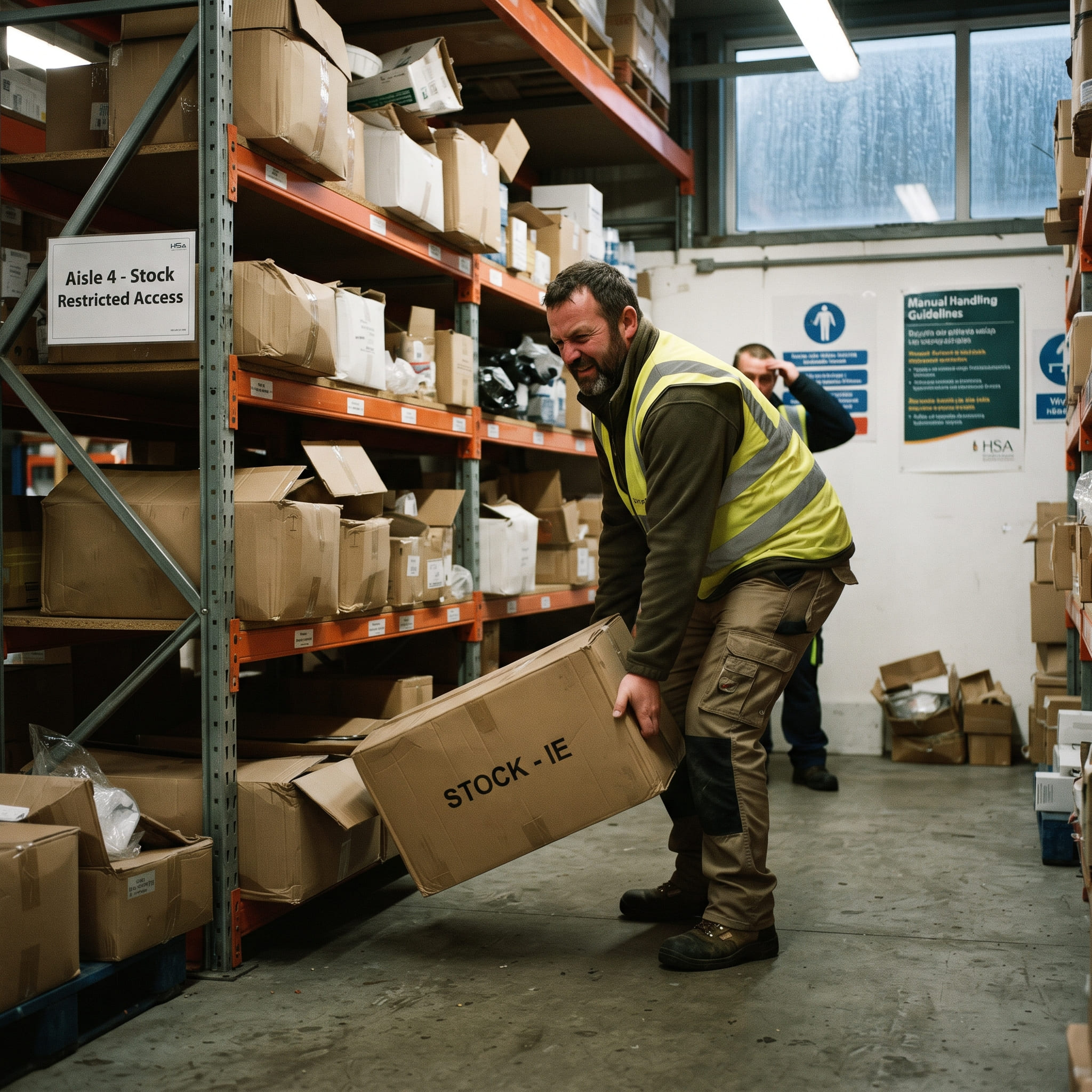
How Storage Affects Manual Handling
The location of an item determines how an employee must access it.
For example, imagine a box weighing 10 kg.
If it is stored at a convenient height with clear access, an employee may be able to retrieve it relatively easily.
If the same box is stored:
- On the floor,
- Behind other boxes,
- Above shoulder height,
- In a narrow space,
the physical demands can be considerably different.
The weight has not changed, but the handling task has.
This demonstrates why manual handling risk assessment should consider the entire task rather than weight alone.
Floor-Level Storage
Items stored directly on the floor often require employees to bend down to retrieve them.
If this happens occasionally, the physical demand may be relatively low.
However, repeatedly lifting items from floor level throughout a working day can create additional physical demands.
Employers should consider whether frequently handled items can be stored at a more accessible height.
Excessively High Storage
Storing items too high can also create problems.
Employees may need to:
- Reach above shoulder height.
- Stretch.
- Stand on unsuitable objects.
- Pull items towards themselves.
- Lower unstable loads.
Heavy or awkward items should not be positioned where employees cannot comfortably control them.
Suitable storage arrangements should take the characteristics of the load and frequency of handling into account.
Overloaded Shelves
Overloaded shelving can create several problems.
Items may become unstable, difficult to access or difficult to remove individually.
Employees may also need to move several products before reaching the item they want.
Shelving should be appropriate for the loads being stored, and workplace procedures should address safe storage practices.
Poorly Organised Stockrooms
A disorganised stockroom can increase manual handling because employees may repeatedly move products simply to access other items.
For example:
Box A blocks Box B.
An employee moves Box A.
They then discover that Box C is behind Box B.
More handling is required.
This is sometimes called unnecessary or double handling.
Better organisation can reduce the number of times employees have to move the same items.
Reduce Double Handling
One effective way to improve storage safety is to reduce unnecessary movement.
Businesses should consider where products go after delivery.
If an item is temporarily placed in one location and later moved to another, employees have handled it twice.
Where practical, stock should be directed to its intended storage location as efficiently as possible.
Reducing unnecessary handling can improve both safety and productivity.
Store Frequently Used Items Within Easy Reach
The frequency with which an item is used should be considered when designing storage arrangements.
Frequently accessed products or equipment may be more suitable for locations that are easy to reach.
Less frequently used items may be stored elsewhere, provided that the storage arrangement remains safe.
This approach can reduce repeated bending, reaching and carrying.
Consider the Weight of Stored Items
Storage systems should take load weight into account.
Heavy items may be more appropriate for lower or easily accessible storage positions, depending on the circumstances.
Lightweight items may be easier to store higher up.
The important point is to avoid creating situations where employees regularly have to handle heavy or awkward loads from unsuitable positions.
Avoid Storing Items Behind Other Items
Blocked storage can increase manual handling.
If an employee has to move several boxes to reach one product, each of those boxes becomes an additional handling task.
A clear storage system can make it easier to retrieve products without unnecessary movement.
Consider Storage Height
Storage height can affect posture and movement.
Employees may have to:
- Bend.
- Crouch.
- Reach.
- Stretch.
- Twist.
Where these movements are repeated, the storage arrangement should be reviewed.
Small changes to shelf positioning can sometimes make routine tasks considerably easier.
Keep Storage Areas Clear
Storage areas should have appropriate access routes.
Boxes, packaging and equipment should not unnecessarily obstruct walkways.
A clear route is particularly important when employees are carrying loads.
An employee carrying a box may have reduced visibility, making obstacles more difficult to identify.
Avoid Blocking Access Routes
Stock should not be placed where it interferes with:
- Doorways.
- Walkways.
- Emergency exits.
- Fire equipment.
- Workplace machinery.
- Access to frequently used areas.
Poor storage can create both manual handling hazards and wider workplace safety risks.
Consider the Route From Storage to Destination
The storage position is only one part of the task.
Employers should also consider what happens after the item is removed.
For example:
Shelf → trolley → workstation
may be significantly easier than:
Shelf → employee carries item → long corridor → stairs → workstation
Reducing carrying distances can reduce physical demands.
Use Trolleys Where Appropriate
If employees regularly move several items between storage and another part of the workplace, a trolley may reduce unnecessary carrying.
Trolleys should be:
- Suitable for the load.
- Maintained properly.
- Loaded safely.
- Used on suitable surfaces.
Employees should also ensure that the route is clear.
Consider Pallet Storage
Warehouses and distribution environments often use pallets.
Palletised stock can reduce individual handling when suitable mechanical equipment is available.
However, pallet storage must be organised appropriately.
Employees should not manually move loads that require mechanical handling equipment simply because the equipment is unavailable or inconvenient to use.
Poor Storage and Repetitive Handling
Storage problems can become particularly significant when employees perform repetitive tasks.
For example, a retail worker may restock shelves hundreds of times during a working week.
A warehouse employee may retrieve dozens or hundreds of boxes each day.
A healthcare worker may repeatedly access supplies.
Even relatively light loads can create significant physical demands when the task is repeated frequently.
Poor Storage Can Encourage Unsafe Shortcuts
When storage is poorly organised, employees may develop shortcuts.
They may:
- Reach over other boxes.
- Pull items from unstable piles.
- Carry several items at once.
- Twist while retrieving products.
- Climb onto unsuitable surfaces.
- Drag heavy objects.
These behaviours can develop simply because the storage arrangement makes the safer option inconvenient.
Good workplace design should make safe behaviour easier.
Risk Assessment of Storage Arrangements
Employers should consider storage as part of their manual handling risk assessment.
Questions can include:
What is being stored?
Consider weight, size, shape and stability.
How often is it handled?
Frequent handling deserves particular attention.
Where is it stored?
Consider height, access and surrounding space.
How is it removed?
Does retrieval require bending, reaching or twisting?
Where does it go?
Consider carrying distances and routes.
Can handling be reduced?
Could equipment or better organisation reduce the task?
Manual Handling Training Ireland
Professional Manual Handling Training Ireland can help employees understand how workplace storage can influence handling risks.
Training can cover:
- Load assessment.
- Risk assessment.
- Safe lifting.
- Carrying.
- Pushing and pulling.
- Posture.
- Team handling.
- Mechanical aids.
Employees can apply these principles when retrieving products and equipment from storage areas.
Manual Handling Course Ireland
A suitable Manual Handling Course Ireland can help workers understand that safe lifting does not begin when an employee grabs a box.
It begins with planning.
Before removing an item, employees should consider:
Where is the item stored?
Can I reach it safely?
Is anything blocking it?
Is the load stable?
Where am I taking it?
Do I need assistance?
This approach encourages employees to identify problems before lifting begins.
Manual Handling Certificate Ireland
Employees who complete appropriate training may receive a Manual Handling Certificate Ireland.
The certificate provides evidence that relevant training has been completed.
However, training does not eliminate risks created by poor storage.
Employers should still assess storage areas and introduce suitable controls.
The safest approach combines employee knowledge with appropriate workplace design.
How Employers Can Improve Storage Safety
Businesses can take several practical steps.
1. Review Frequently Handled Items
Identify products and equipment employees access regularly.
2. Consider Load Weight
Avoid creating difficult lifting positions for heavier items.
3. Improve Accessibility
Make frequently handled stock easier to retrieve.
4. Reduce Double Handling
Move products directly to their intended storage locations where practical.
5. Keep Routes Clear
Ensure employees can move safely between storage and work areas.
6. Provide Handling Equipment
Use suitable trolleys and other aids where appropriate.
7. Train Employees
Provide appropriate manual handling instruction.
8. Review Changes
Reassess storage when stock, equipment or workplace layout changes.
What Employees Can Do
Employees also have an important role in maintaining safe storage.
Workers should:
- Keep storage areas organised.
- Avoid overloading shelves.
- Report unstable stock.
- Use handling equipment.
- Ask for assistance when necessary.
- Avoid unsafe climbing.
- Keep walkways clear.
- Report difficult storage arrangements.
If an employee repeatedly struggles to retrieve a particular item, this may indicate that the storage arrangement needs to be reviewed.
Storage Safety and Workplace Efficiency
Improving storage does not only reduce physical demands.
It can also make workplaces more efficient.
A well-organised storage area can help employees:
- Find products faster.
- Reduce unnecessary movement.
- Reduce double handling.
- Keep work areas organised.
- Improve stock control.
Good storage design can therefore support both safety and productivity.
Conclusion
Poor storage can create unnecessary manual handling risks in workplaces across Ireland.
The way products, equipment and materials are positioned can influence how employees bend, reach, lift, carry, push and pull throughout the working day.
Items stored too low or too high, blocked products, overloaded shelves, cluttered stockrooms and long carrying routes can all make routine tasks more physically demanding.
Employers should therefore consider storage arrangements as part of their wider manual handling risk management.
Frequently handled items should be accessible where practical, heavy or awkward loads should be positioned appropriately, storage routes should remain clear and unnecessary double handling should be reduced.
Professional Manual Handling Training Ireland can help employees recognise hazards and understand how to approach lifting and carrying tasks safely. A suitable Manual Handling Course Ireland can provide knowledge about risk assessment, safe lifting, posture, carrying, pushing, pulling and the use of handling equipment.
A Manual Handling Certificate Ireland demonstrates that relevant training has been completed, but effective injury prevention requires more than training alone.
By combining appropriate training with better storage design, good housekeeping, suitable handling equipment and regular risk assessment, Irish businesses can reduce unnecessary lifting risks and create safer, more organised and more efficient workplaces.