



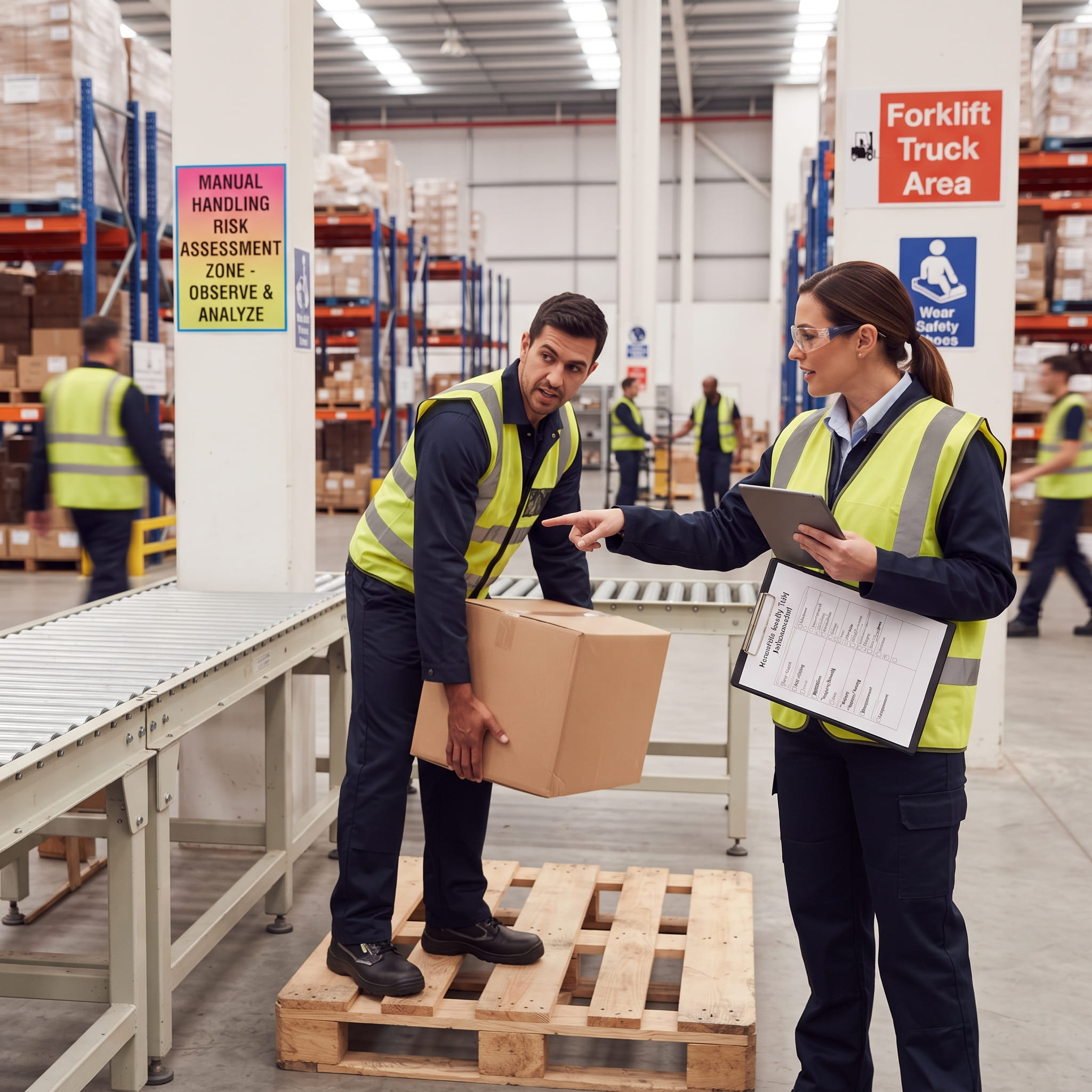
Manual handling is an important part of many workplaces across Ireland. Employees in construction, healthcare, warehouses, manufacturing, retail, logistics, hospitality and other industries may regularly lift, carry, push, pull or move loads as part of their daily work.
Many of these activities may appear routine. However, a task that seems simple can become high-risk when it involves heavy or awkward loads, repetitive movements, uncomfortable working positions, long carrying distances or unsuitable workplace conditions.
For employers, identifying these risks is an important first step towards preventing workplace injuries.
Under Irish workplace safety requirements, employers must assess risks associated with manual handling and take appropriate measures to avoid or reduce those risks. Where hazardous manual handling cannot be avoided, work should be organised and suitable measures implemented to protect employees.
Professional Manual Handling Training Ireland can help employees recognise hazards during everyday tasks, but employers also have an important responsibility to identify and control risks at an organisational level.
A suitable Manual Handling Course Ireland can teach workers how to assess loads and apply safer techniques. However, training should form part of a wider approach that includes risk assessment, workplace design, mechanical aids and effective work organisation.
This article explains how employers can identify high-risk manual handling tasks and what they can do to make those tasks safer.
What Makes a Manual Handling Task High Risk?
There is rarely one single factor that automatically makes a task dangerous.
Risk can increase when several factors occur together.
For example, an employee may repeatedly lift a moderately heavy box from floor level, twist and carry it several metres to another workstation.
The individual weight may not appear extreme, but the combination of:
- Repetition.
- Bending.
- Twisting.
- Carrying.
- Poor workstation design.
can increase the overall physical demands.
Employers should therefore assess the complete task rather than focusing on weight alone.
Start by Observing the Task
One of the best ways to identify risks is to observe employees performing their normal work.
Do not rely exclusively on written procedures.
Watch what actually happens.
Look for:
- How employees pick up loads.
- How far they carry them.
- How frequently they repeat the task.
- Whether they twist or reach.
- Whether they use mechanical aids.
- Whether obstacles affect the route.
- Whether employees appear fatigued.
Employees may develop practical shortcuts over time that are not included in formal procedures.
Observing the real task can reveal these issues.
Speak to Employees
Employees who perform manual handling every day can provide valuable information.
Ask them:
- Which loads are most difficult?
- Which tasks are repeated most often?
- Are there awkward storage areas?
- Are mechanical aids easy to access?
- Are there difficult routes?
- Are there tasks they consider unnecessarily demanding?
Workers may identify risks that are not immediately obvious to managers.
Encouraging employees to report problems also contributes to a stronger workplace safety culture.
Assess the Weight of the Load
Load weight is an important consideration, but it should not be the only factor.
Employers should determine:
- How heavy the load is.
- Whether the weight is evenly distributed.
- Whether the load can shift.
- Whether the load is easy to grip.
- Whether the object is bulky.
An object that is relatively light but difficult to control may create significant handling challenges.
Look at the Size and Shape
Large and awkward loads can create additional risks.
For example, a bulky object may:
- Block visibility.
- Require two people.
- Require employees to reach around it.
- Make turning difficult.
- Prevent a secure grip.
Employers should consider whether the load can be redesigned, divided into smaller units or moved using mechanical equipment.
Identify Repetitive Tasks
Repetition is one of the most important factors employers should consider.
A task may involve a relatively light load but be performed hundreds of times during a shift.
Examples include:
- Packing products.
- Loading shelves.
- Sorting materials.
- Moving boxes.
- Handling deliveries.
- Repositioning equipment.
Employers should record how frequently these movements occur and how long employees perform them.
Check for Awkward Postures
Observe whether employees regularly work in positions that require:
- Bending.
- Twisting.
- Reaching.
- Stretching.
- Squatting.
- Working above shoulder height.
A task that repeatedly forces employees into awkward positions may require redesign.
For example, moving frequently used materials from floor-level storage to a more accessible location may reduce unnecessary bending.
Assess Carrying Distances
The distance a load is carried can influence the overall physical demands of the task.
Employers should identify situations where employees regularly carry loads over significant distances.
Ask:
Can the load be moved closer to where it is needed?
Can a trolley be used?
Can the workplace layout be changed?
Reducing unnecessary carrying distances can make a significant difference when the same task is performed repeatedly.
Examine Pushing and Pulling
Manual handling risk assessments should not focus exclusively on lifting.
Pushing and pulling can also require significant physical effort.
Employers should assess:
- The weight of the load.
- The type of equipment.
- Wheel condition.
- Floor surfaces.
- Slopes.
- Obstacles.
- Distance.
- Frequency.
A trolley that moves easily on a smooth surface may be considerably harder to control on an uneven floor.
Review Workplace Layout
Workplace layout can create unnecessary manual handling risks.
Look at:
- Storage heights.
- Workstation locations.
- Walkways.
- Doorways.
- Equipment positioning.
- Delivery areas.
- Floor conditions.
Poor layout can force employees to repeatedly bend, reach, twist or carry materials unnecessarily.
Small changes to the physical environment can sometimes reduce these risks considerably.
Check Storage Arrangements
Storage is particularly important.
Frequently handled materials should, where practical, be stored in accessible locations.
Employers should avoid arrangements that require employees to:
- Reach excessively.
- Lift from the floor repeatedly.
- Handle objects above shoulder height.
- Move other items before accessing the required load.
Good storage can reduce unnecessary handling.
Consider Mechanical Aids
Employers should identify tasks where mechanical assistance could reduce manual handling.
Possible solutions include:
- Trolleys.
- Pallet trucks.
- Hoists.
- Lift tables.
- Conveyors.
- Powered handling equipment.
The objective should be to eliminate or reduce unnecessary manual handling where reasonably practicable.
Equipment should also be suitable for the task and maintained properly.
Identify Tasks That Require Team Handling
Some loads are simply unsuitable for one person.
Employers should identify tasks involving:
- Large objects.
- Long objects.
- Bulky equipment.
- Unstable loads.
- Loads that restrict visibility.
Where team handling is appropriate, employees should receive suitable instruction on communication and coordination.
Consider the Environment
The surrounding environment can significantly affect risk.
Employers should look for:
- Wet floors.
- Uneven surfaces.
- Poor lighting.
- Narrow walkways.
- Temperature extremes.
- Clutter.
- Slopes.
- Obstacles.
An otherwise manageable load can become much more difficult when the surrounding conditions are poor.
Consider Frequency and Duration
A complete assessment should consider not only what employees lift but how often and for how long.
Ask:
- How many times is the task performed?
- How long does each handling session last?
- Is the task performed continuously?
- Does fatigue develop?
- Are there opportunities to vary the work?
Repetitive manual handling can create different risks from occasional handling.
Look for Signs of Fatigue
Employees who regularly perform demanding manual tasks may experience fatigue.
Employers should observe whether workers:
- Slow down significantly.
- Take longer to complete tasks.
- Lose concentration.
- Struggle to control loads.
- Use shortcuts.
- Report increasing difficulty.
Fatigue should be considered when reviewing the organisation of manual handling work.
Assess Individual Circumstances
Employees are not identical.
Differences in:
- Experience.
- Training.
- Physical capability.
- Familiarity with equipment.
- Work experience.
can affect how a task is performed.
Employers should ensure that employees have suitable instruction and that tasks are organised appropriately.
Risk assessment should focus on the actual work rather than making assumptions about individual workers.
Review New and Changed Tasks
A task should be reassessed when something changes.
For example:
- A new piece of equipment is introduced.
- Storage locations change.
- Loads become heavier.
- Production increases.
- The workplace layout changes.
- A new process is introduced.
A task that was previously manageable may become higher risk after a change.
Use Employee Feedback and Incident Information
Employers can also review:
- Accident reports.
- Near misses.
- Employee complaints.
- Maintenance records.
- First-aid reports.
- Previous risk assessments.
Patterns can reveal which manual handling activities require further attention.
If several employees report difficulty with the same task, it should be investigated rather than treated as an individual problem.
Prioritise High-Risk Tasks
Once risks have been identified, employers should prioritise them.
Consider which tasks involve the greatest combination of:
- Heavy loads.
- Awkward objects.
- Repetition.
- Force.
- Poor posture.
- Long distances.
- Difficult environments.
The highest-risk activities should receive attention first.
Manual Handling Training Ireland
Professional Manual Handling Training Ireland can support the identification and management of manual handling hazards.
Training can help employees understand:
- Load assessment.
- Risk assessment.
- Safe lifting.
- Carrying.
- Pushing and pulling.
- Team handling.
- Mechanical aids.
- Workplace hazards.
Employees who understand these principles can contribute more effectively to identifying risks during their everyday work.
Manual Handling Course Ireland
A suitable Manual Handling Course Ireland can help employees develop practical awareness.
However, training should not be used as a substitute for fixing obvious workplace hazards.
For example, if employees repeatedly have to lift heavy materials because there is no suitable handling equipment, simply teaching them a lifting technique does not address the underlying problem.
Employers should consider whether the task itself can be eliminated, redesigned or mechanically assisted.
Manual Handling Certificate Ireland
Employees who complete appropriate training may receive a Manual Handling Certificate Ireland.
A certificate provides evidence that training has been completed.
Employers can maintain training records and use training as part of their overall safety management system.
However, certification alone does not make a high-risk task safe.
Workplace hazards still need to be identified and controlled.
What Employers Can Do After Identifying a Risk
Once a high-risk task has been identified, employers can consider several solutions.
These may include:
Eliminate the Manual Handling
Can the task be removed completely?
Reduce the Load
Can materials be divided into smaller quantities?
Use Mechanical Equipment
Can a trolley, hoist or other aid be introduced?
Improve the Workplace Layout
Can storage or equipment be repositioned?
Reduce Repetition
Can the process be redesigned?
Improve Training
Do employees need additional instruction?
Improve Supervision
Do employees need further guidance?
The best solution will depend on the specific task.
Regularly Review Risk Assessments
Manual handling risk assessment should not be treated as a one-time exercise.
Workplaces change.
New equipment, employees, materials and processes can introduce new risks.
Employers should review assessments when:
- An incident occurs.
- A new process is introduced.
- Equipment changes.
- Employees report a problem.
- Workplace layout changes.
- The nature of the load changes.
Regular review helps ensure that controls remain effective.
Conclusion
Identifying high-risk manual handling tasks is an essential part of creating safer workplaces across Ireland.
Employers should look beyond simply asking how heavy a load is. A complete assessment should consider the load, task, environment, individual and frequency of the work.
High-risk activities may involve heavy or awkward objects, repetitive lifting, excessive reaching, bending, twisting, long carrying distances, difficult pushing and pulling, poor workplace layout or unsuitable equipment.
Observing employees, speaking with workers, reviewing incidents and examining workplace conditions can help employers identify where improvements are needed.
Professional Manual Handling Training Ireland can help employees recognise hazards and apply safer working practices. A suitable Manual Handling Course Ireland can cover risk assessment, safe lifting, carrying, pushing, pulling, team handling and mechanical aids.
A Manual Handling Certificate Ireland provides evidence of completed training, but training should be only one part of a wider risk management strategy.
The most effective approach is to identify hazards early, eliminate unnecessary manual handling where possible, introduce suitable mechanical assistance, improve workplace design and provide employees with appropriate training.
By regularly reviewing manual handling tasks and listening to the people who perform them every day, Irish employers can reduce unnecessary physical demands and create safer, more efficient workplaces.