



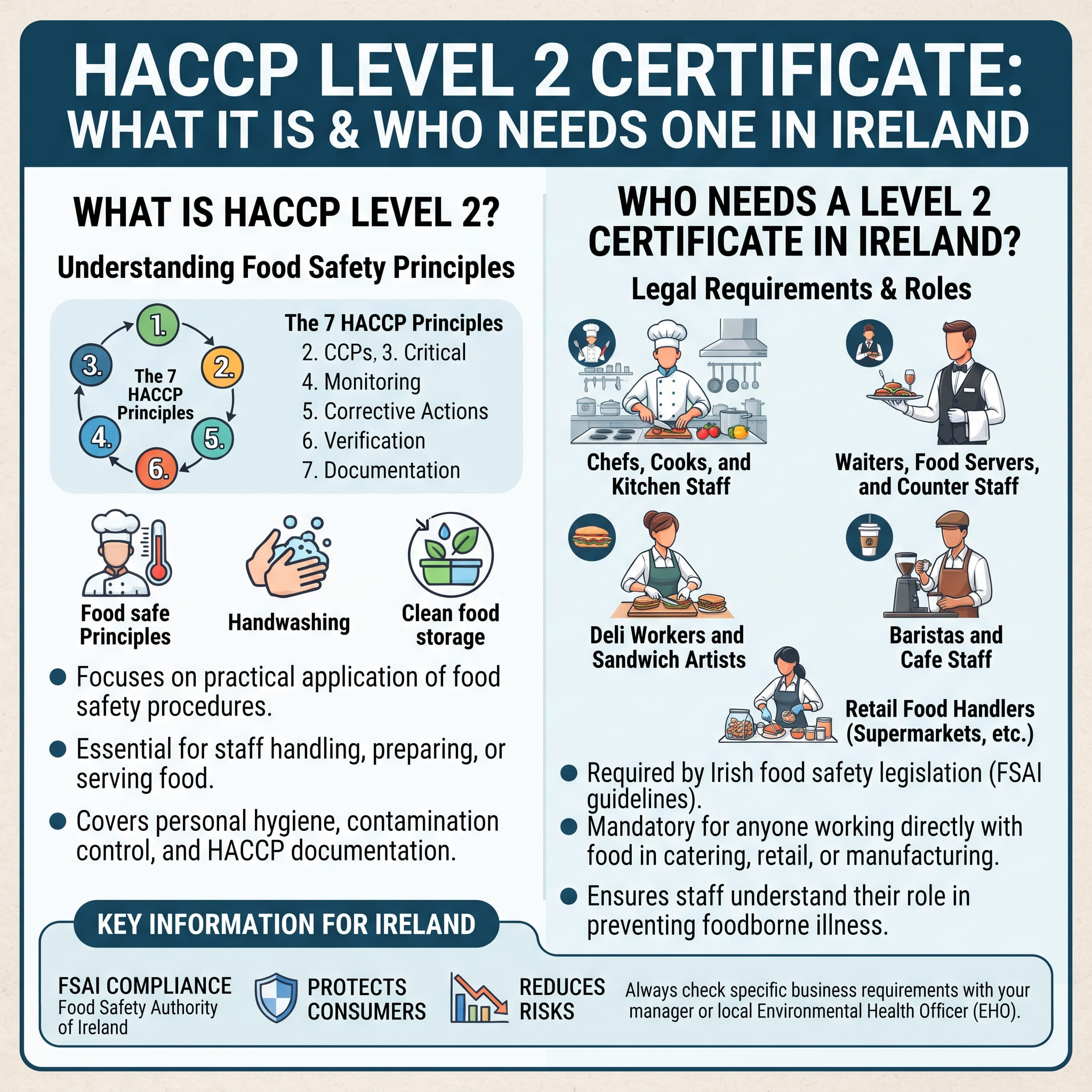
A HACCP Level 2 certificate is commonly associated with food safety training for people who have greater responsibility for handling, preparing, storing or managing food. In Ireland, understanding HACCP is an important part of operating a food business safely, because food businesses need effective food safety procedures based on HACCP principles.
But what exactly does a HACCP Level 2 certificate mean? Who should complete this type of training, and what can you expect to learn from a HACCP Level 2 course?
This guide explains the role of HACCP Level 2 training in Ireland, who may benefit from it, and why HACCP knowledge is important for maintaining safe food practices.
What Is HACCP?
HACCP stands for Hazard Analysis and Critical Control Points. It is a systematic approach to identifying, evaluating and controlling hazards that could affect food safety.
Rather than relying solely on checking the finished food product, HACCP focuses on identifying potential hazards throughout the food preparation and handling process.
These hazards can include:
- Biological hazards such as bacteria and viruses
- Chemical hazards such as cleaning chemicals
- Physical hazards such as glass, metal or other foreign objects
- Allergen-related risks
- Problems with temperature control
- Cross-contamination
- Poor food storage practices
A HACCP-based food safety system allows a business to identify where problems could occur and establish controls to reduce the risk.
For food businesses in Ireland, HACCP is therefore an important component of food safety management.
What Is a HACCP Level 2 Certificate?
A HACCP Level 2 certificate is evidence that a person has completed a relevant Level 2 HACCP training course.
The exact content and assessment requirements can vary between training providers, so it is important to check what a particular HACCP certification course covers before enrolling.
Generally, HACCP Level 2 training provides a more detailed understanding of food safety hazards and HACCP procedures than introductory training.
A typical HACCP course may cover topics such as:
- HACCP terminology
- Food safety hazards
- Hazard analysis
- Control measures
- Critical Control Points
- Critical limits
- Monitoring procedures
- Corrective actions
- Verification
- HACCP documentation
- Food contamination
- Temperature control
- Personal hygiene
- Cross-contamination
- Allergen management
The purpose is not simply to provide a HACCP certification. The training should help workers understand how food safety controls are applied in a real workplace.
Who Needs HACCP Level 2 Training?
There is not one single job title that determines whether someone needs HACCP Level 2 training.
The appropriate level of training depends on the person's role, responsibilities, experience and involvement with food safety procedures.
HACCP training Level 2 can be particularly relevant to employees who are directly involved in food preparation, handling or supervision.
Examples can include:
Chefs and Cooks
Chefs and cooks are responsible for many activities that can directly affect food safety.
They may prepare raw ingredients, cook food, cool prepared dishes, store food and serve customers. Each stage can involve potential food safety hazards.
HACCP Level 2 training can help kitchen staff understand how hazards can be controlled during these activities.
Kitchen Supervisors
Supervisors often have additional responsibilities compared with general food handlers.
They may monitor temperatures, check cleaning procedures, supervise employees and ensure food safety procedures are followed.
A stronger understanding of HACCP principles can help supervisors identify problems and take appropriate corrective action.
Food Handlers
Employees who regularly handle food can also benefit from HACCP food safety training.
This can include people working in:
- Restaurants
- Cafés
- Takeaways
- Hotels
- Catering businesses
- Bakeries
- Food manufacturing
- Delis
- Supermarkets
- Care facilities
- Other food service environments
The training should help employees understand why specific food safety procedures are required rather than simply following instructions without understanding the reason behind them.
Do Managers Need HACCP Level 2 Training?
Managers and supervisors may have responsibilities that go beyond normal food handling.
For example, they may be involved in implementing food safety procedures, monitoring controls, maintaining records or supervising staff.
For these roles, HACCP training can be particularly useful.
However, the correct training level should be determined according to the person's actual duties and the food safety responsibilities assigned to them.
A manager who is responsible for overseeing HACCP procedures may require more advanced knowledge than an employee whose role is limited to basic food handling.
What Do You Learn on a HACCP Level 2 Course?
A good HACCP Level 2 course should provide practical knowledge rather than focusing exclusively on terminology.
Understanding Food Safety Hazards
One of the first areas covered is understanding what can make food unsafe.
Biological hazards can include harmful microorganisms. Chemical hazards can involve cleaning products, pesticides or other substances. Physical hazards can include foreign objects that accidentally enter food.
Understanding these categories helps food workers recognise potential problems in their workplace.
Understanding Critical Control Points
A Critical Control Point, or CCP, is a stage where control can be applied to prevent, eliminate or reduce a food safety hazard to an acceptable level.
For example, cooking can be a critical control point because appropriate cooking conditions can help control certain biological hazards.
Employees need to understand why particular stages of a food process require careful monitoring.
Monitoring Critical Limits
HACCP systems establish critical limits for relevant control points.
Depending on the food process, this may involve factors such as temperature, time or other measurable conditions.
Monitoring helps identify when a process is operating outside the established limits.
Corrective Actions
What happens if a critical limit is not met?
A HACCP system should establish corrective actions.
Employees and supervisors need to understand what action should be taken when a food safety control fails.
This might involve holding affected food, correcting a process, investigating the cause of the problem or recording the incident.
HACCP Level 2 and Food Hygiene
HACCP and food hygiene are closely connected, but they are not exactly the same thing.
Food hygiene covers the practices used to keep food safe and prevent contamination. This can include personal hygiene, cleaning, food storage and safe food handling.
HACCP provides a systematic approach to identifying and controlling food safety hazards throughout a process.
For example, washing hands correctly is an important food hygiene practice. Identifying where hand hygiene is necessary to prevent contamination can form part of a broader food safety management system.
For this reason, food safety and HACCP training can complement each other.
Is HACCP Level 2 the Same as Food Safety Level 2?
Not necessarily.
Different training providers can use different course names and structures. A course described as Level 2 Food Safety, for example, is not automatically identical to a course specifically called HACCP Level 2.
Although the subjects can overlap, HACCP training focuses specifically on the HACCP approach and the management of food safety hazards.
When choosing a course, check the syllabus carefully to make sure it covers the knowledge required for your particular role.
Can You Complete HACCP Level 2 Training Online?
Yes, HACCP training online can be a convenient option for many learners.
An online HACCP course allows employees and businesses to complete training without necessarily having to attend a classroom at a fixed location.
An online HACCP certification course may include:
- Video lessons
- Written learning material
- Knowledge checks
- Online assessments
- Multiple exam attempts
- Digital certificates
The exact format depends on the training provider.
Before enrolling, learners should check what is included in the HACCP certification online, how the assessment works and what certification is provided after successful completion.
How Long Does HACCP Level 2 Training Take?
The duration of a HACCP Level 2 course varies between providers.
Some online HACCP training courses are designed to be completed relatively quickly, while classroom-based programmes may take longer depending on the syllabus and assessment structure.
The important consideration is not simply how quickly a certificate can be obtained. The training should provide sufficient information for the learner to understand the HACCP principles relevant to their role.
How Long Is a HACCP Certificate Valid?
There is not necessarily one universal expiry period that applies to every HACCP certification.
The appropriate refresher period can depend on the person's role, workplace requirements, changes to procedures and the employer's food safety training policy.
Employers should ensure that employees remain suitably trained and competent for the work they perform.
It is therefore useful to keep training records and review HACCP knowledge regularly rather than treating certification as a one-time requirement.
Why Is HACCP Training Important for Irish Food Businesses?
Food safety problems can have serious consequences for both customers and businesses.
Poor food handling can contribute to foodborne illness, contamination, allergen incidents and other food safety problems.
HACCP food safety training helps employees understand the potential hazards associated with their work and the controls used to manage them.
For businesses, effective HACCP training can also help create a stronger food safety culture.
Employees who understand why HACCP procedures are important are more likely to recognise unsafe practices and take appropriate action.
Choosing a HACCP Level 2 Course
If you are looking for HACCP Level 2 training in Ireland, consider the following before choosing a course:
1. Check the course syllabus
Make sure the HACCP course covers the HACCP principles and subjects relevant to your job.
2. Check whether assessment is included
Find out how learners are assessed and what happens after successful completion.
3. Check the certificate
Understand what HACCP certificate is issued and what information it contains.
4. Consider online accessibility
If you need flexible training, an online HACCP course may be more convenient than attending a classroom.
5. Consider the training provider
Look at the provider's course information, contact details, learner support and terms before purchasing.
6. Match the training to your responsibilities
Someone responsible for supervising HACCP procedures may need different training from someone whose role involves basic food handling.
Final Thoughts
A HACCP Level 2 certificate can demonstrate that a learner has completed training covering important HACCP and food safety principles. It can be particularly relevant to people involved in food preparation, food handling, kitchen supervision and other roles where food safety controls are important.
The value of HACCP training goes beyond obtaining a certificate. The real objective is to understand how food safety hazards can arise, how they can be controlled and what to do when controls are not working as intended.
For anyone working in an Irish food business, choosing appropriate HACCP training is an important step towards developing the knowledge needed to handle food safely and support effective food safety procedures.