



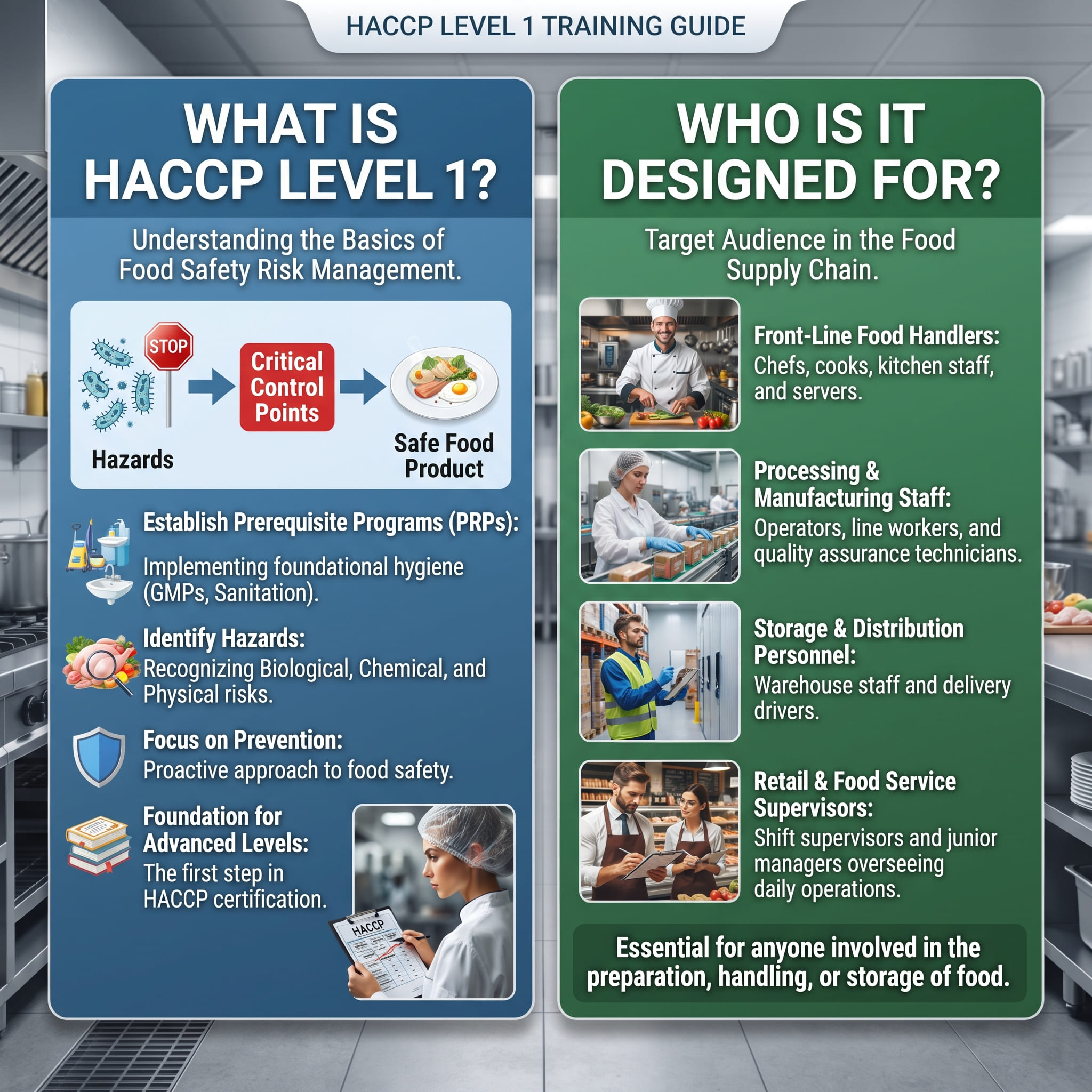
If you work in the food industry, you may have come across the term HACCP Level 1 when looking for food safety training. But what does HACCP Level 1 actually mean, and who should complete this type of training?
HACCP stands for Hazard Analysis and Critical Control Points. It is a systematic approach used to identify, control and monitor food safety hazards. HACCP training helps employees understand how food can become unsafe and what controls are used to reduce those risks.
HACCP Level 1 is generally associated with introductory food safety and HACCP knowledge. However, course levels are not necessarily identical across all training providers. The actual syllabus, intended audience and assessment should therefore always be checked before enrolling.
For people beginning work in a food environment, Level 1 training can provide an important foundation for understanding food safety responsibilities.
What Is HACCP?
HACCP means Hazard Analysis and Critical Control Points.
The system focuses on identifying potential hazards before they cause a food safety problem.
Food safety hazards can include:
- Biological hazards
- Chemical hazards
- Physical hazards
- Allergen-related hazards
- Cross-contamination
- Temperature-related risks
- Poor storage practices
Instead of relying solely on finished-product testing, HACCP focuses on controlling hazards throughout the food process.
The Food Safety Authority of Ireland (FSAI) describes HACCP as a systematic approach that helps food businesses identify what could go wrong, plan how to prevent problems and ensure that controls are being followed.
This makes HACCP an important part of food safety management.
What Does HACCP Level 1 Mean?
HACCP Level 1 is generally intended to provide basic or introductory knowledge of food safety and HACCP principles.
It is commonly aimed at people who work with food but do not have primary responsibility for developing or managing a HACCP system.
The exact meaning of "Level 1" can vary between training providers.
This is important because there is no reason to assume that every course advertised as HACCP Level 1 contains exactly the same material.
Before enrolling, check:
- The course syllabus
- Intended audience
- Learning outcomes
- Assessment
- Certificate
- Training provider
- Employer requirements
The FSAI's Guide to Food Safety Skills uses Level 1 to describe basic food safety skills that food handlers should demonstrate.
Who Is HACCP Level 1 Designed For?
HACCP Level 1 can be suitable for people who need a basic understanding of food safety as part of their work.
This can include:
- New food handlers
- Kitchen assistants
- Catering staff
- Restaurant employees
- Café workers
- Takeaway staff
- Bakery employees
- Supermarket food workers
- Hospitality employees
- People beginning work in food preparation
The exact suitability depends on the person's responsibilities.
If an employee has responsibility for managing or maintaining HACCP procedures, introductory Level 1 training may not be sufficient.
HACCP Level 1 for New Food Handlers
New employees may have limited experience with food safety.
They may understand basic hygiene from everyday life but still need workplace-specific knowledge.
A HACCP Level 1 course can introduce important concepts such as:
- Personal hygiene
- Food contamination
- Cross-contamination
- Food storage
- Temperature control
- Cleaning
- Basic HACCP principles
This provides a foundation before employees take on more responsibility.
What Will You Learn on HACCP Level 1?
The exact syllabus depends on the provider, but introductory training can cover several important areas.
Food Safety Basics
The course may begin by explaining what food safety means and why it matters.
Learners can be introduced to foodborne illness, contamination and the role food handlers play in protecting consumers.
Biological Hazards
You may learn about microorganisms such as:
- Bacteria
- Viruses
- Parasites
- Fungi
The course can explain how these hazards can contaminate food and how appropriate hygiene and temperature controls can reduce risks.
Chemical Hazards
Chemical hazards can include cleaning products and other substances that could contaminate food.
Learners can be introduced to the importance of storing and using chemicals appropriately.
Physical Hazards
Physical hazards include foreign objects such as:
- Glass
- Metal
- Plastic
- Stones
- Packaging materials
Employees should learn how physical contamination can occur and why damaged equipment or packaging should be reported.
Cross-Contamination
Cross-contamination is an important subject for food handlers.
It can occur when contaminants are transferred between:
- Raw and ready-to-eat foods
- Hands
- Equipment
- Utensils
- Work surfaces
- Storage containers
A Level 1 course can explain how cross-contamination happens and what basic controls can help prevent it.
For example, appropriate separation of raw and ready-to-eat foods and effective cleaning procedures can reduce contamination risks.
Personal Hygiene
Personal hygiene is one of the most important responsibilities of food handlers.
HACCP Level 1 training may cover:
- Hand hygiene
- Personal cleanliness
- Suitable protective clothing
- Workplace hygiene procedures
- Reporting relevant illness or symptoms
Employees need to understand how their own actions can affect food safety.
Good personal hygiene is not simply a matter of appearance. It can help reduce the risk of transferring contaminants to food.
Food Storage
Food storage is another important subject.
Employees may learn about:
- Refrigerated storage
- Frozen storage
- Dry storage
- Protecting food from contamination
- Separation of raw and ready-to-eat foods
- Stock rotation
The exact procedures should always follow the requirements of the workplace.
A course provides general knowledge, while the employer's HACCP system establishes the specific procedures employees need to follow.
Temperature Control
Temperature can be an important control in food safety.
Depending on the food business, employees may need to understand temperature control during:
- Cooking
- Cooling
- Refrigeration
- Storage
- Hot holding
HACCP Level 1 can introduce the importance of temperature control and explain why employees must follow the procedures established by their employer.
If a worker is responsible for taking temperature readings, they should understand what needs to be checked and what to do if a result is outside the required limit.
Cleaning and Hygiene
Cleaning helps prevent contamination and supports the wider food safety system.
A Level 1 course can introduce:
- Cleaning food-contact surfaces
- Cleaning equipment
- Maintaining hygienic preparation areas
- Safe handling of cleaning products
- The importance of following cleaning schedules
Employees should understand that cleaning procedures need to be followed consistently rather than only when an area visibly appears dirty.
Introduction to HACCP Principles
Although Level 1 is generally introductory, learners should gain an understanding of the purpose of HACCP.
The HACCP system is based on seven principles:
- Conduct a hazard analysis
- Determine Critical Control Points
- Establish critical limits
- Establish monitoring procedures
- Establish corrective actions
- Establish verification procedures
- Establish documentation and record keeping
A Level 1 learner may not be responsible for designing these controls, but understanding their purpose helps explain why workplace procedures exist.
The FSAI identifies these seven principles as the foundation of HACCP-based food safety management.
What Is a Critical Control Point?
A Critical Control Point, or CCP, is a stage where control is essential to prevent, eliminate or reduce a food safety hazard to an acceptable level.
For example, depending on the food process, a cooking step may be used to control certain biological hazards.
Level 1 training can introduce the concept of CCPs so that employees understand that some stages of food preparation require particularly careful control.
Employees responsible for monitoring CCPs may require more detailed HACCP training.
HACCP Level 1 vs HACCP Level 2
One of the most common questions is whether HACCP Level 1 and HACCP Level 2 are the same.
They are generally aimed at different levels of responsibility, but the exact content varies between training providers.
A basic comparison might look like this:
| HACCP Level 1 | HACCP Level 2 |
|---|---|
| Introductory knowledge | More detailed knowledge |
| Generally aimed at food handlers | Often aimed at more experienced staff |
| Basic food safety principles | More detailed HACCP principles |
| Understanding hazards | Greater focus on HACCP controls |
| Following workplace procedures | Potentially greater responsibility for monitoring |
| Foundation-level training | More advanced training |
However, you should always compare the actual course syllabus.
A provider's Level 1 and Level 2 courses may differ significantly from another provider's courses.
Does HACCP Level 1 Make You Responsible for the HACCP System?
No.
Completing a HACCP Level 1 course does not automatically make someone responsible for designing, implementing or managing a business's HACCP system.
In many workplaces, Level 1 training is intended to help employees understand and follow existing food safety procedures.
People responsible for developing and maintaining HACCP-based procedures have different training requirements.
The FSAI states that those responsible for developing and maintaining HACCP-based procedures must have adequate training in applying HACCP principles.
Therefore, employees should understand the difference between being trained to follow food safety procedures and being responsible for managing those procedures.
Can You Complete HACCP Level 1 Online?
Yes, HACCP Level 1 online courses are available.
Online training can be convenient for employees who:
- Work shifts
- Have changing schedules
- Cannot easily travel
- Prefer self-paced learning
An online course may include:
- Video lessons
- Written material
- Interactive modules
- Knowledge checks
- Online assessments
- Digital certificates
However, the same considerations apply when choosing an online course.
Check the syllabus, intended audience, assessment and certificate before enrolling.
Is HACCP Level 1 Enough for Every Food Worker?
Not necessarily.
The correct level of training depends on the person's responsibilities.
For someone who simply handles food under established procedures, introductory training may be appropriate.
For someone who supervises staff, monitors CCPs or helps manage the HACCP system, more detailed training may be necessary.
The FSAI's guidance emphasises that food safety training should be appropriate to the employee's role, responsibilities and the activities of the food business.
This is why employers should consider job responsibilities rather than giving every employee exactly the same training automatically.
How Long Does HACCP Level 1 Take?
There is no single duration for every HACCP Level 1 course.
Course length depends on:
- Course provider
- Learning material
- Assessment
- Delivery method
- Course structure
Some online courses can be completed relatively quickly, while classroom programmes may follow a different schedule.
Do not choose a course simply because it is the shortest.
The important question is whether it provides the knowledge required for the learner's role.
What Should You Check Before Enrolling?
Before purchasing HACCP Level 1, check:
Course Syllabus
What exactly will you learn?
Intended Audience
Is the course designed for food handlers?
Assessment
Is there an examination or knowledge assessment?
Certificate
What does the certificate demonstrate?
Delivery
Is it online, classroom-based or blended?
Employer Requirements
Does your employer require a particular level or provider?
Training Provider
Is there clear information about the provider and the training offered?
These checks can help prevent you from choosing a course that is unsuitable for your responsibilities.
Final Thoughts
HACCP Level 1 provides an introduction to food safety and HACCP concepts for people who work with food and need foundational knowledge.
It can cover subjects such as biological, chemical and physical hazards, cross-contamination, personal hygiene, cleaning, food storage, temperature control and the basic principles of HACCP.
It is generally most relevant to food handlers and employees who need to understand and follow established food safety procedures.
However, the term HACCP Level 1 can mean slightly different things depending on the training provider. Always check the course syllabus and intended audience before enrolling.
If you are responsible for developing, maintaining or managing HACCP-based procedures, you may require more advanced training.
Whether completed online or in a classroom, the purpose of HACCP Level 1 training is to give food workers a strong foundation in safe food handling and help them understand their responsibilities in maintaining food safety at work.