



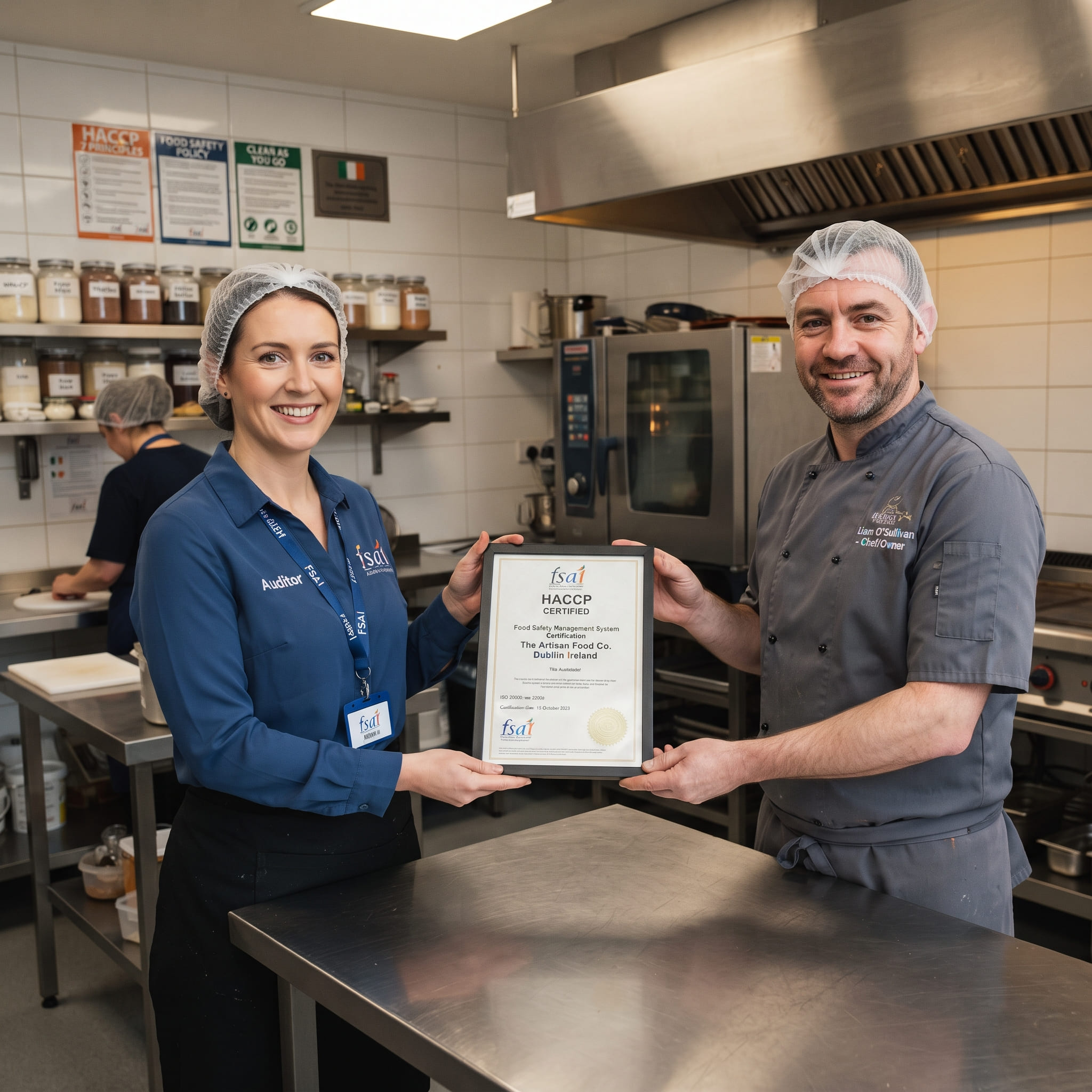
If you work in the food industry in Ireland, you may have come across the term HACCP certification when looking for food safety training. HACCP is an important part of food safety management, and people working in food businesses need appropriate knowledge and training for their roles.
But what does it actually mean to be HACCP certified in Ireland? Is a HACCP certificate legally required for every food worker? Can you complete HACCP certification online, and how do you choose the right course?
This guide explains how HACCP certification works, who may need HACCP training and what to look for when choosing a HACCP certification course in Ireland.
What Is HACCP?
HACCP stands for Hazard Analysis and Critical Control Point. It is a systematic approach to identifying and controlling food safety hazards.
These hazards can be:
- Biological, such as harmful bacteria and viruses
- Chemical, such as cleaning chemicals
- Physical, such as glass, metal or other foreign objects
- Allergen-related
- Associated with poor temperature control or cross-contamination
The Food Safety Authority of Ireland (FSAI) explains that HACCP-based procedures are designed to identify what could go wrong, plan how to prevent it and make sure those controls are being followed.
For food businesses in Ireland, HACCP is therefore not simply a voluntary food safety concept. Food businesses are required to have appropriate food safety management arrangements based on HACCP principles, although the way the requirement is met can depend on the nature and complexity of the business.
What Is HACCP Certification?
A HACCP certificate is generally issued to a learner after successfully completing a HACCP training course and any required assessment.
The certificate provides evidence that the person has completed the particular training programme offered by that provider.
It is important to understand that a HACCP training certificate and a food business's HACCP system are not the same thing.
A certificate demonstrates that an individual has completed training. A HACCP system is the food safety management system used by a business to identify and control hazards.
The FSAI states that people responsible for developing and maintaining HACCP-based procedures must have adequate training in the application of HACCP principles.
Is HACCP Certification Legally Required in Ireland?
This is one of the most important questions to understand.
Irish food safety requirements focus on appropriate training and competence, rather than simply requiring every employee to hold a particular certificate with a specific title.
The FSAI states that food handlers must be supervised and instructed and/or trained in food hygiene according to the level of activity they carry out. It also states that people responsible for developing and maintaining HACCP-based procedures must receive adequate training in applying HACCP principles.
Therefore, it would be inaccurate to say that every food worker in Ireland must legally hold a specific "HACCP certificate."
The training required depends on the person's role and responsibilities.
A formal course can nevertheless provide a convenient way of demonstrating that appropriate training has been completed.
Who Needs HACCP Training?
HACCP training in Ireland can be relevant to many different food industry roles.
This can include:
- Chefs
- Cooks
- Food handlers
- Kitchen staff
- Catering employees
- Restaurant supervisors
- Café employees
- Takeaway workers
- Food production employees
- Food business managers
- Supervisors responsible for food safety
- People involved in developing or maintaining HACCP procedures
The level of training should be appropriate to the work being performed.
The FSAI's food safety training guidance describes different levels of food safety skills depending on employees' experience and responsibilities, with management and supervisory roles requiring additional skills.
How Do You Get HACCP Certified in Ireland?
Getting a HACCP certification is generally straightforward.
1. Choose an Appropriate HACCP Course
The first step is to find a course that matches your role.
You may find courses described as:
- HACCP training
- HACCP course
- HACCP Level 1
- HACCP Level 2
- HACCP food safety training
- HACCP certification course
- Online HACCP course
Do not choose a course simply because it contains the word "HACCP."
Check the syllabus, level, assessment and certificate details before enrolling.
2. Check the Course Content
A suitable HACCP course should cover the principles that are relevant to your responsibilities.
The seven HACCP principles include identifying hazards, determining Critical Control Points, establishing critical limits, monitoring controls, taking corrective action, verification and documentation.
A course may also cover practical food safety subjects such as:
- Food contamination
- Cross-contamination
- Temperature control
- Personal hygiene
- Cleaning
- Food storage
- Allergen management
- HACCP records
- Corrective actions
The exact content depends on the training provider and course level.
3. Complete the Training
Once enrolled, you work through the course material.
If you choose HACCP certification online, you may be able to study remotely using a computer, laptop, tablet or another compatible device.
Online training can be particularly convenient for food workers who have changing shifts or cannot easily attend classroom sessions.
However, the important factor is the quality and suitability of the training, rather than whether it is delivered online or in person.
4. Complete the Assessment
Many HACCP certification courses include an assessment at the end of the training.
The assessment may test your understanding of subjects such as:
- HACCP principles
- Food safety hazards
- Critical Control Points
- Monitoring
- Corrective actions
- Food contamination
- Temperature control
The assessment format varies between providers.
Before purchasing a course, check whether an assessment is included and what is required to successfully complete it.
5. Receive Your Certificate
After successfully completing the required training and assessment, the provider can issue your HACCP certificate.
Depending on the provider, this may be available as a digital certificate that you can save or print.
Keep a copy of your certificate and any associated training records, particularly if your employer requires evidence of completed training.
What Are the Seven HACCP Principles?
Understanding the seven principles is central to HACCP training.
1. Identify the Hazards
The first step is to identify what could go wrong during the food operation.
Hazards can be biological, chemical or physical.
2. Identify Critical Control Points
A Critical Control Point, or CCP, is a stage where control can be applied to prevent, eliminate or reduce a food safety hazard to an acceptable level.
3. Establish Critical Limits
Critical limits establish boundaries that separate acceptable conditions from unacceptable conditions at a CCP.
For example, a particular cooking process may have a specified time and temperature requirement.
4. Establish Monitoring Procedures
Businesses need procedures for monitoring their CCPs.
Monitoring can involve measurements such as time or temperature, depending on the process.
5. Establish Corrective Actions
If monitoring shows that a CCP is not under control, appropriate corrective action needs to be taken.
6. Establish Verification Procedures
Verification helps confirm that the HACCP system is working effectively.
The system should also be reviewed when relevant changes are made to the food operation.
7. Keep Documentation and Records
Appropriate records provide evidence that HACCP procedures are being followed and monitored.
The amount of documentation required can depend on the size and complexity of the food business.
Can You Get HACCP Certification Online?
Yes, HACCP certification online is an option offered by many training providers.
Online learning can allow employees to complete training without travelling to a training centre.
A typical online HACCP course may contain:
- Online learning modules
- Videos
- Written material
- Knowledge checks
- Online examination
- Digital certificate
Before enrolling, check exactly what is included.
It is also worth confirming that the course is appropriate for your particular job responsibilities.
The FSAI itself provides online learning resources, while noting that its learning portal is intended to supplement wider food safety training programmes tailored to individual businesses and staff roles.
How Long Is a HACCP Certificate Valid?
There is not a single universal legal expiry period for every HACCP training certificate.
Training should instead be viewed as an ongoing process.
The FSAI notes that there is no legal requirement for refresher training after one specific fixed period. Refresher training may nevertheless be appropriate when employees need to update their knowledge or following an inspection where an inspector identifies a need for additional training.
Employers should therefore consider whether employees continue to have the knowledge and skills required for their roles.
Additional training may also be appropriate when workplace procedures, equipment, products or responsibilities change.
HACCP Certificate vs HACCP Plan
These terms are sometimes confused.
A HACCP certificate relates to an individual who has completed training.
A HACCP plan or HACCP-based food safety system relates to the food business and its procedures for identifying and controlling food safety hazards.
Completing an online HACCP course does not create a HACCP plan for a restaurant, café or food manufacturing business.
The business itself remains responsible for ensuring that its food safety management arrangements are appropriate.
The FSAI states that responsibility for safe food ultimately lies with the food business operator.
How to Choose a HACCP Certification Course
Before choosing a HACCP certification course in Ireland, consider the following:
Check the Syllabus
Make sure the course covers HACCP principles and subjects relevant to your role.
Check the Level
An introductory course may be appropriate for some food handlers, while supervisors and people involved in HACCP procedures may require more detailed training.
Check the Assessment
Find out whether you need to complete an examination or assessment before receiving your certificate.
Check the Certificate
Look at what certificate is issued and what information it contains.
Check Online Access
If you want HACCP training online, make sure you understand how long you have access to the course and what devices are supported.
Check Employer Requirements
If you are completing training for your employer, confirm which course or level they require before purchasing.
Why HACCP Certification Matters
Food safety depends on people understanding the risks associated with their work.
Training can help employees understand why food safety procedures exist and how their actions can affect customers.
For example, an employee who understands cross-contamination is more likely to recognise why raw and ready-to-eat foods need to be handled appropriately.
Someone responsible for HACCP procedures needs a deeper understanding of hazards, Critical Control Points, monitoring and corrective actions.
This is why training should be appropriate to the individual's actual responsibilities.
Final Thoughts
Obtaining HACCP certification in Ireland generally involves choosing appropriate HACCP training, completing the course material, passing any required assessment and receiving a certificate from the training provider.
However, HACCP certification should not be confused with the legal requirement for a food business to maintain appropriate food safety management arrangements.
Irish food safety requirements focus on appropriate training and competence for people's roles. Those responsible for developing and maintaining HACCP-based procedures must have adequate training in the application of HACCP principles.
Whether you choose a classroom programme or HACCP certification online, the most important consideration is that the training is suitable for your responsibilities and gives you a practical understanding of food safety hazards and the HACCP principles used to control them.