



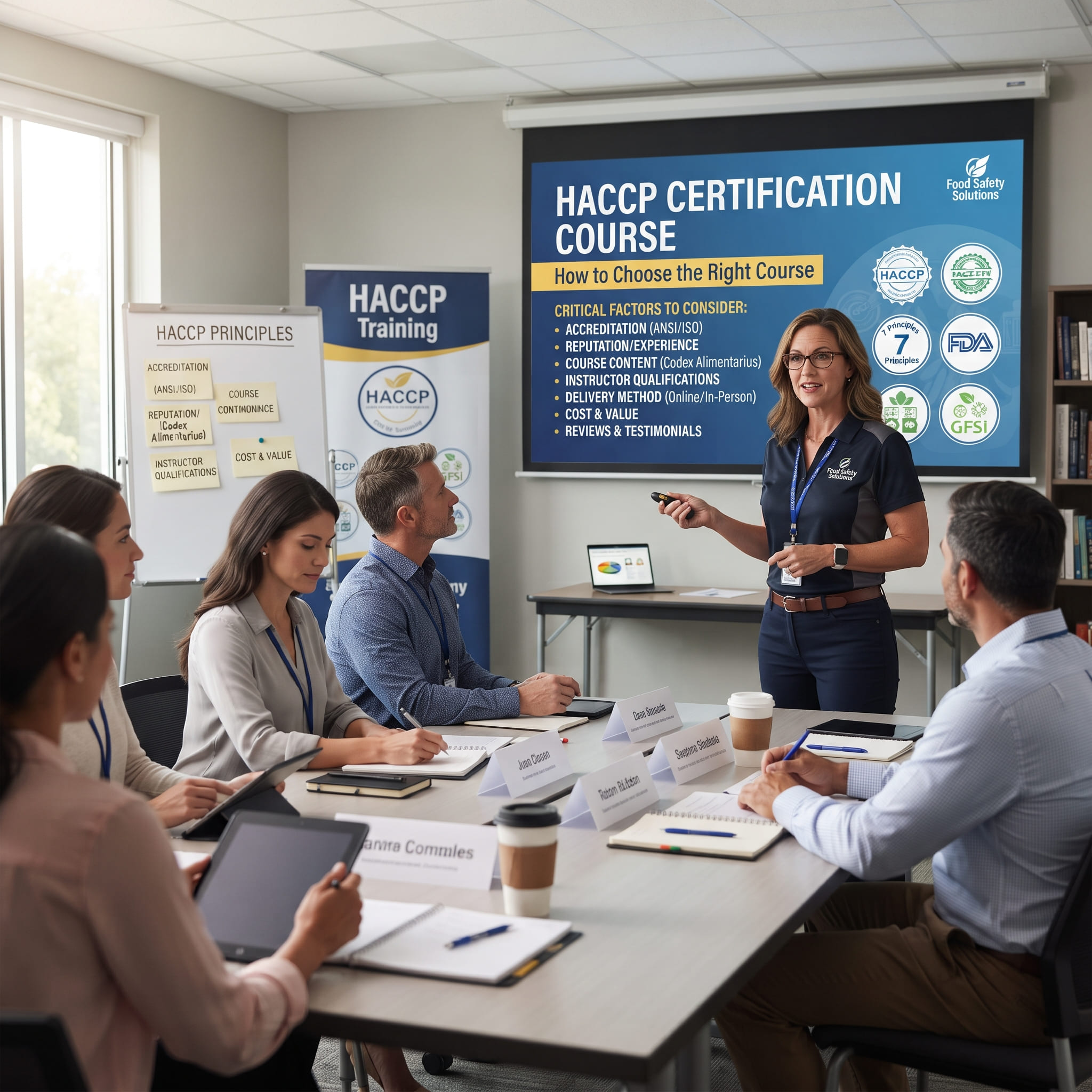
Choosing the right HACCP certification course can be confusing when there are many different options available online and in the classroom. Courses can vary in level, duration, content, assessment methods and certification.
The right course for a food handler may not be the same as the right course for a chef, supervisor, manager or person responsible for developing and maintaining HACCP procedures.
In Ireland, food handlers must receive food hygiene instruction or training appropriate to their work activity, while people responsible for developing and maintaining HACCP-based procedures must have adequate training in applying HACCP principles.
This guide explains what to look for when choosing a HACCP certification course in Ireland, whether you are considering classroom or HACCP certification online.
What Is a HACCP Certification Course?
A HACCP certification course is a training programme that teaches learners about Hazard Analysis and Critical Control Points.
HACCP is a systematic approach to identifying and controlling hazards that could affect food safety. The Food Safety Authority of Ireland (FSAI) describes HACCP as a system that helps businesses identify what could go wrong, plan how to prevent it and make sure the controls are being followed.
Potential hazards can include:
- Biological hazards such as harmful bacteria
- Chemical hazards such as cleaning chemicals
- Physical hazards such as glass or metal
- Allergen-related hazards
- Cross-contamination
- Incorrect temperature control
- Unsafe storage practices
A HACCP certificate normally provides evidence that an individual has completed a particular training programme and any required assessment.
It is important to distinguish this from a business's HACCP system. Completing a HACCP course does not create or replace the food business's own food safety management procedures.
Why Is Choosing the Right HACCP Course Important?
Not every HACCP training course is designed for the same audience.
A basic course may introduce food handlers to HACCP terminology and fundamental food safety practices. A more detailed course may cover hazard analysis, Critical Control Points, monitoring, corrective actions and documentation.
The FSAI's current Guide to Food Safety Skills emphasises that training should be appropriate and relevant to the needs of the food business and the employee's level of responsibility.
Choosing the right course therefore starts with one simple question:
What are you responsible for in the workplace?
Start With Your Job Role
Your responsibilities should be one of the first things you consider when selecting HACCP training.
Food Handlers
Food handlers need appropriate food hygiene training for the work they perform.
This can include people working in:
- Restaurants
- Cafés
- Takeaways
- Hotels
- Catering businesses
- Bakeries
- Supermarkets
- Food production
- Delis
The training may cover personal hygiene, cross-contamination, temperature control, cleaning, food storage and basic HACCP principles.
Chefs and Cooks
Chefs and cooks can have greater responsibility for food preparation and may benefit from more detailed HACCP training.
They may need to understand how hazards can arise during preparation, cooking, cooling and storage.
Supervisors and Managers
Supervisors and managers can have additional responsibilities for monitoring food safety procedures and supervising employees.
For these roles, a more detailed course may be appropriate.
People Responsible for HACCP Procedures
If you are responsible for developing or maintaining HACCP-based procedures, your training needs are more specific.
Irish food safety requirements state that people responsible for these procedures must have adequate training in the application of HACCP principles.
This is an important distinction when choosing a HACCP certification course.
Check the Course Level
You may see courses advertised as:
- HACCP Level 1
- HACCP Level 2
- HACCP food safety training
- HACCP supervisor training
- HACCP management training
- HACCP certification online
However, do not choose a course based solely on its title.
Course levels and descriptions can vary between training providers.
The FSAI Guide to Food Safety Skills uses levels to describe the food safety skills employees should demonstrate at different stages and levels of responsibility. Its guidance currently identifies Level 1 as basic food safety skills, Level 2 as additional skills that staff should demonstrate after gaining more experience, and Level 3 as skills for managers and supervisors.
This means you should examine the actual syllabus rather than assuming that every course labelled "Level 2" has identical content.
Check What the HACCP Course Covers
Before purchasing an HACCP course, read the course syllabus carefully.
A comprehensive course should address the relevant HACCP principles.
The seven principles include:
- Identifying food safety hazards
- Determining Critical Control Points
- Establishing critical limits
- Establishing monitoring procedures
- Establishing corrective actions
- Establishing verification procedures
- Maintaining appropriate documentation and records
The FSAI identifies these seven principles as the foundation of HACCP-based food safety management.
A course should explain these principles in a way that is appropriate for the learner's role.
Look for Practical Food Safety Content
A good HACCP certification course should not rely entirely on theoretical definitions.
Food workers need to understand how HACCP relates to everyday activities.
Look for relevant information about:
Cross-Contamination
Learners should understand how harmful microorganisms or other contaminants can move between raw food, ready-to-eat food, hands, equipment and surfaces.
Temperature Control
Training should explain the importance of appropriate temperature controls during cooking, chilling, refrigeration, storage and other relevant processes.
Personal Hygiene
Employees should understand how hand hygiene and personal cleanliness contribute to preventing food contamination.
Cleaning
Training should address how effective cleaning and appropriate use of cleaning products help maintain a safe food environment.
Allergen Control
Where relevant to the role, learners should understand how allergen hazards can be identified and controlled.
These practical subjects help connect HACCP theory with everyday workplace activities.
Understand Critical Control Points
Critical Control Points, or CCPs, are a central part of HACCP.
The FSAI explains that a CCP is a point where control is essential to prevent, eliminate or reduce a hazard to an acceptable level.
For example, certain cooking processes can be used to control biological hazards.
A good HACCP training course should explain not only what a CCP is but also how it is monitored and what happens if the required control is not achieved.
This is particularly important for employees who have responsibility for monitoring food safety procedures.
Check Monitoring and Corrective Actions
HACCP is based on maintaining control, not simply identifying hazards.
Learners should understand the purpose of monitoring.
Depending on the food operation, monitoring can involve checking factors such as time or temperature and keeping appropriate records.
The course should also explain corrective actions.
If monitoring shows that a CCP is not under control, appropriate corrective action must be taken.
Understanding this process can be particularly important for supervisors and employees who are responsible for monitoring HACCP procedures.
Consider Online HACCP Certification
For many learners, HACCP certification online can be a convenient alternative to classroom training.
Online courses can allow employees to study around their working schedules without travelling to a training centre.
An online HACCP course may include:
- Video lessons
- Written learning material
- Interactive modules
- Knowledge checks
- Online assessments
- Digital certificates
The FSAI also provides its own Learning Portal with online resources, while explaining that its materials are intended to supplement a wider food safety training programme tailored to the business and staff roles.
When choosing commercial online training, therefore, consider the actual content and suitability rather than assuming that online delivery automatically makes a course appropriate.
Check the Assessment
Another important factor is the assessment.
Before purchasing a HACCP certification course, find out how you demonstrate that you have completed the training.
The course may include:
- Multiple-choice questions
- Knowledge checks
- A final examination
- Practical questions
- Other assessment methods
Check whether there is a minimum pass mark and what happens if you do not pass the first time.
If the course offers multiple attempts, make sure the provider clearly explains how the assessment works.
Examine the Certificate
Before enrolling, look at what the HACCP certificate actually contains.
Depending on the provider, it may include:
- Your name
- Course title
- Training level
- Completion date
- Certificate number
- Training provider
- Assessment information
Do not assume that every certificate with "HACCP" in the title represents the same qualification.
The FSAI specifically advises that enforcement officers will not necessarily require a certificate from a particular training course. They can instead assess staff hygiene practices, food safety knowledge and relevant records.
This is why the quality and relevance of the training matter more than the certificate alone.
Check the Training Provider
The training provider is another important consideration.
The FSAI recommends looking at factors such as the trainer's food safety qualifications, food industry experience, training skills, follow-up support and whether the provider is interested in understanding the specific needs of the business.
Before buying an HACCP certification course, look for clear information about:
- The training provider
- Course syllabus
- Trainer or training organisation
- Assessment
- Certificate
- Learner support
- Contact information
- Terms and conditions
A transparent provider should make it easy to understand what you are actually purchasing.
Don't Choose Only by Price
Price is important, especially if a business needs to train several employees.
However, the cheapest HACCP course is not automatically the best option.
Compare what is included.
For example, one course might have a low headline price but limited learning material, while another might include comprehensive modules, assessment, support and certification.
Look at the total value rather than simply choosing the lowest price.
Check Course Duration
Course duration is another factor to consider.
Some online HACCP courses can be completed relatively quickly, while others contain more extensive learning material.
A short course is not necessarily poor quality, and a long course is not automatically better.
The important question is whether the training provides sufficient knowledge for the learner's responsibilities.
The aim should be meaningful learning rather than simply obtaining a certificate as quickly as possible.
Check Whether Your Employer Has Requirements
If you are completing HACCP training because your employer has requested it, ask what they require before enrolling.
They may specify:
- A particular HACCP level
- Specific subjects
- A particular training provider
- Online or classroom delivery
- A particular certificate
This can save you from completing a course that does not meet the employer's expectations.
Does the Course Suit Your Business?
If you are choosing training for employees rather than yourself, consider the actual food operation.
The FSAI notes that food safety training should be relevant to the business and staff roles. Its current guidance takes into account factors such as responsibility, the risk level of the work area and the employee's experience.
For example, the training needs of a small café may differ from those of a large food manufacturing operation.
The course should help employees understand the hazards and controls that are relevant to their work.
HACCP Certification Course Checklist
Before enrolling, ask yourself:
- Is the course appropriate for my role?
- What HACCP level is it?
- What subjects are covered?
- Does it explain the seven HACCP principles?
- Does it include an assessment?
- What certificate will I receive?
- Is online access available?
- How long can I access the course?
- Is learner support provided?
- Does the course meet my employer's requirements?
- Is the training provider transparent about its qualifications and experience?
- Does the course provide practical food safety knowledge?
If you can answer these questions, you can make a much more informed decision.
Final Thoughts
Choosing the right HACCP certification course is about more than finding a course that provides a certificate.
The most important factors are the learner's responsibilities, the level of training, the course syllabus, the assessment and the quality of the training provider.
For food handlers, appropriate food hygiene and HACCP knowledge can help them perform their daily duties safely. For supervisors and managers, more detailed training may be required. People responsible for developing and maintaining HACCP-based procedures need adequate training in applying HACCP principles.
If flexibility is important, HACCP certification online can be a convenient option. However, whether you choose online or classroom training, always look beyond the certificate itself.
The best HACCP course is one that matches your responsibilities, provides relevant and practical knowledge, and helps you understand how food safety hazards are identified, controlled and monitored in the workplace.