



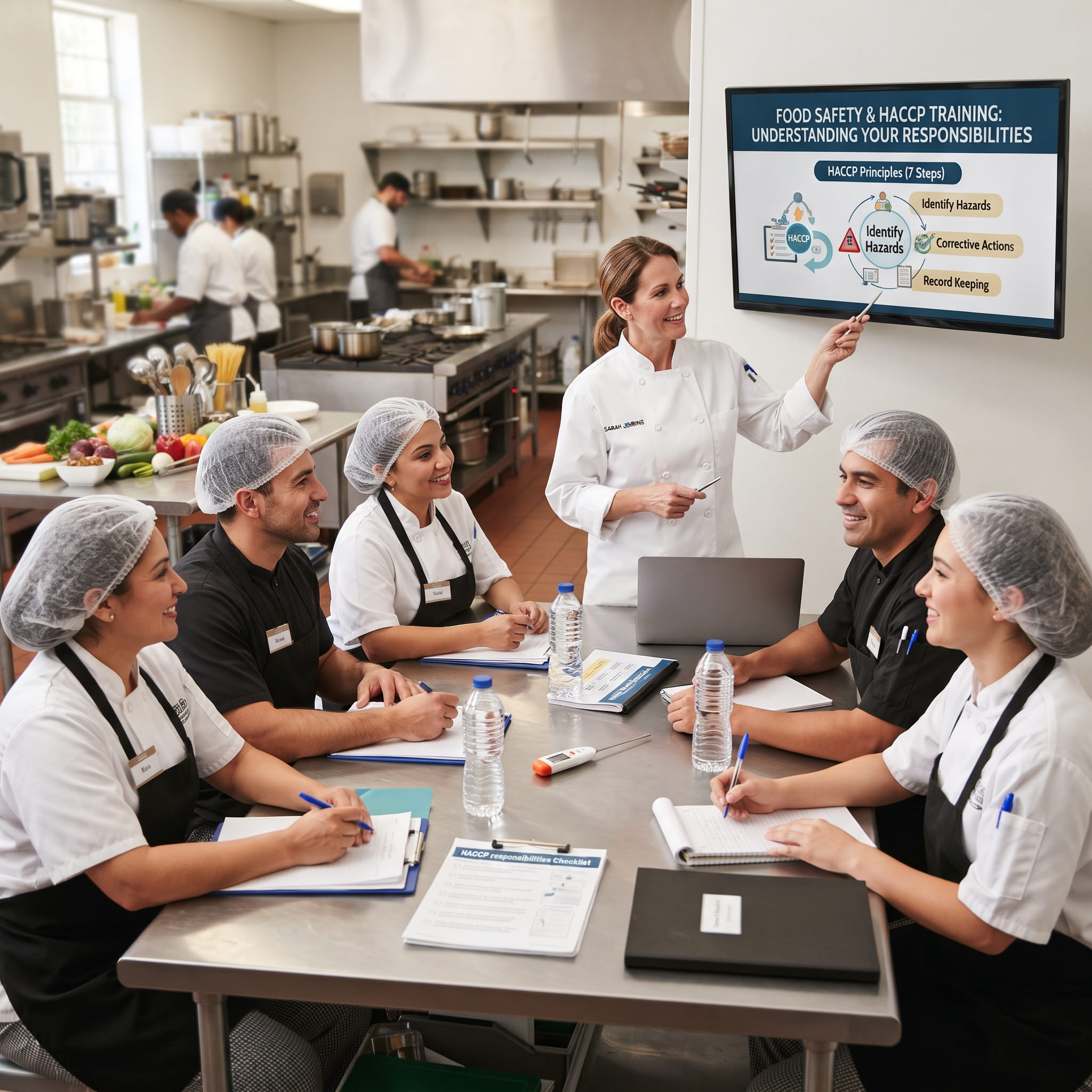
Working with food comes with important responsibilities. Whether you are a chef, kitchen assistant, waiter, food handler, supervisor, manager or food business operator, the way you handle food can affect the safety of the people who consume it.
This is why food safety and HACCP training are important in the food industry. Training helps employees understand potential hazards, follow appropriate controls and recognise what they should do when something goes wrong.
HACCP provides a structured approach to identifying and controlling food safety hazards. However, HACCP is not only about paperwork or completing a course. It is about applying appropriate controls consistently in the workplace.
Understanding your individual responsibilities is therefore an important part of effective HACCP training.
What Is Food Safety and HACCP Training?
Food safety training teaches people how to handle food safely and reduce the risk of contamination and foodborne illness.
HACCP training focuses specifically on the principles of Hazard Analysis and Critical Control Points.
HACCP helps food businesses identify potential hazards, establish controls and monitor whether those controls are working.
Potential hazards can include:
- Biological hazards
- Chemical hazards
- Physical hazards
- Allergens
- Cross-contamination
- Incorrect temperature control
- Poor storage practices
The Food Safety Authority of Ireland (FSAI) explains that HACCP is a systematic approach that helps food businesses identify what could go wrong, plan how to prevent problems and ensure that controls are followed.
For employees, this means understanding both the general principles of food hygiene and the specific food safety procedures used in their workplace.
Why Are Food Safety Responsibilities Important?
Food safety is a shared responsibility.
A business can have carefully designed procedures, but those procedures are only effective if employees understand them and follow them correctly.
For example, a restaurant may have procedures for:
- Refrigeration
- Cooking
- Cleaning
- Food storage
- Allergen management
- Temperature monitoring
- Receiving deliveries
If employees do not follow those procedures, food safety controls can fail.
This is why appropriate food safety and HACCP training is so important.
Training helps employees understand not only what they should do but also why the procedures matter.
Your Responsibilities as a Food Handler
Food handlers have an important role in preventing contamination.
A food handler can include anyone who handles food as part of their work.
This may include people working in:
- Restaurants
- Cafés
- Hotels
- Takeaways
- Catering
- Bakeries
- Supermarkets
- Food manufacturing
- Delis
Your responsibilities can include following workplace hygiene procedures, maintaining appropriate personal hygiene and handling food in accordance with the business's food safety system.
Personal Hygiene
Personal hygiene is one of the fundamental responsibilities of a food handler.
This includes appropriate hand hygiene and following workplace rules relating to clothing, cleanliness and illness.
Hands can transfer contamination to food, utensils and surfaces, so employees need to understand when and how to wash their hands.
Training can help explain why seemingly simple actions can have an important impact on food safety.
Preventing Cross-Contamination
Another important responsibility is preventing cross-contamination.
Contamination can be transferred through:
- Hands
- Utensils
- Equipment
- Cutting boards
- Work surfaces
- Storage containers
- Raw food
For example, raw food and ready-to-eat food may require appropriate separation and handling procedures.
Employees should understand the controls used by their workplace and follow them consistently.
Understanding Food Safety Hazards
An important part of HACCP training is learning how to recognise different types of hazards.
Biological Hazards
These include harmful microorganisms such as bacteria, viruses and parasites.
Biological hazards can be controlled through appropriate hygiene, temperature control, cooking, storage and other procedures.
Chemical Hazards
Chemical hazards can include cleaning products or other substances that could contaminate food.
Employees must follow workplace procedures for storing, handling and using chemicals.
Physical Hazards
Physical hazards include foreign objects that could enter food, such as glass, metal or plastic.
Employees should report damaged equipment or other potential sources of physical contamination.
Allergen Hazards
Allergen control is another important responsibility.
Employees need to understand the procedures used by their workplace to prevent allergen cross-contact and provide appropriate information to customers where required.
Your Responsibility for Temperature Control
Temperature can be an important food safety control.
Depending on the food operation, employees may be responsible for monitoring:
- Refrigerators
- Freezers
- Cooking processes
- Cooling processes
- Hot holding
- Food storage
The exact controls and limits depend on the food business and its HACCP system.
If employees are required to take temperature readings, they should understand:
- What needs to be measured
- When it needs to be measured
- How it should be recorded
- What to do if the result is outside the required limit
Simply taking a measurement is not enough if employees do not know what to do with the result.
Understanding Critical Control Points
A major part of HACCP food safety training is understanding Critical Control Points, commonly called CCPs.
A CCP is a step where control is essential to prevent, eliminate or reduce a food safety hazard to an acceptable level.
Not every step in a food process is necessarily a CCP.
The HACCP system identifies which stages require critical control and establishes appropriate procedures for monitoring them.
Employees responsible for CCPs need to understand exactly what their role involves.
Monitoring Your Workplace
Monitoring is an important responsibility for employees involved in HACCP procedures.
Monitoring helps determine whether a control remains effective.
Depending on the business, this might involve checking:
- Temperatures
- Cooking processes
- Storage conditions
- Cleaning procedures
- Other control measures
Employees should record results accurately where records are required.
Never alter or invent a record simply because a result is inconvenient.
Accurate records provide useful evidence about what actually happened and can help identify problems.
What Should You Do When Something Goes Wrong?
One of the most important lessons from HACCP training is that employees need to know what to do when a food safety control fails.
For example:
- A refrigerator may become too warm.
- A cooking process may not achieve the required control.
- Food may be stored incorrectly.
- Equipment may become damaged.
- A cleaning procedure may not be completed correctly.
Employees should follow the corrective action procedures established by the business.
Depending on the situation, this may involve reporting the problem, isolating affected food, repeating a process, correcting equipment problems or taking another appropriate action.
The correct response depends on the specific HACCP system.
Your Responsibilities for Cleaning
Cleaning is another important part of food safety.
Employees may be responsible for cleaning:
- Work surfaces
- Utensils
- Equipment
- Food preparation areas
- Storage areas
Cleaning procedures should be followed according to workplace instructions.
Employees should also understand how cleaning chemicals are handled to avoid chemical contamination.
A good food safety course should explain why effective cleaning supports HACCP controls.
Food Storage Responsibilities
Correct storage is an important part of food safety.
Employees may need to ensure that food is stored according to workplace procedures.
This can include:
- Maintaining appropriate temperatures
- Separating raw and ready-to-eat foods
- Protecting food from contamination
- Checking packaging
- Following stock rotation procedures
- Reporting damaged or unsuitable food
Storage responsibilities vary between food businesses, so employees should always follow their workplace's specific procedures.
Receiving Deliveries
Employees involved in receiving food deliveries can also have important food safety responsibilities.
Depending on the business, they may need to check:
- Packaging
- Product condition
- Delivery temperatures where applicable
- Dates
- Signs of contamination
- Storage requirements
Problems should be reported according to the business's procedures.
Food safety controls should begin when food enters the business, not only when it reaches the kitchen or customer.
Responsibilities of Supervisors and Managers
Supervisors and managers can have additional responsibilities.
Their role may involve:
- Supervising employees
- Ensuring procedures are followed
- Checking monitoring records
- Responding to problems
- Organising training
- Reviewing food safety procedures
- Supporting corrective actions
A manager may also need a more detailed understanding of the business's HACCP system than an employee who simply follows established procedures.
The appropriate level of training should therefore reflect the person's responsibilities.
Responsibilities of People Managing HACCP Systems
Some employees have more specific HACCP responsibilities.
For example, a person may be responsible for developing, implementing or maintaining HACCP-based procedures.
Irish food safety guidance states that people responsible for developing and maintaining HACCP-based procedures must have adequate training in applying HACCP principles.
This is different from basic food handler training.
Someone responsible for a HACCP system needs to understand how hazards are identified, how controls are established and how the system is monitored and verified.
Following Procedures Is Not Enough
It is important to understand why procedures exist.
For example, an employee might know that a particular temperature needs to be checked.
But they should also understand:
What hazard is the control addressing?
What happens if the limit is not achieved?
Who needs to be informed?
What records need to be completed?
This understanding is what makes HACCP training valuable.
Employees who understand the reason behind a control are generally better positioned to recognise potential problems.
Food Safety Training Should Match Your Role
Not everyone needs exactly the same training.
The FSAI's Guide to Food Safety Skills considers factors such as an employee's responsibilities, experience and the activities carried out by the food business.
For example, a new food handler may need fundamental food hygiene knowledge.
A supervisor may need additional knowledge about monitoring and managing food safety procedures.
A person responsible for HACCP procedures may require more detailed training in HACCP principles.
The training should therefore be relevant to the work being performed.
Can Food Safety and HACCP Training Be Completed Online?
Yes, many providers offer food safety and HACCP training online.
Online courses can provide:
- Learning modules
- Videos
- Written material
- Knowledge checks
- Online assessments
- Digital certificates
This can be convenient for employees who work shifts or cannot easily attend classroom training.
However, online training does not remove the need to understand the specific procedures used by the workplace.
An employee still needs to know how their particular business manages food safety.
Keeping Your Knowledge Up to Date
Food safety training should not be viewed as something you complete once and then forget.
The FSAI explains that there is no single legally prescribed fixed period after which every employee must complete refresher training. However, refresher training may be appropriate when an employee needs to update their knowledge or when circumstances indicate additional training is necessary.
Additional training may be particularly useful when:
- Procedures change
- New equipment is introduced
- Employees take on new responsibilities
- New products are introduced
- Problems are identified
- Food safety requirements change
Continued learning helps employees maintain the knowledge needed to perform their roles safely.
A Practical Responsibility Checklist
Every food worker should understand their responsibilities.
Ask yourself:
- Do I know how to maintain appropriate personal hygiene?
- Do I understand how to prevent cross-contamination?
- Do I know the food safety hazards relevant to my work?
- Do I understand my workplace's temperature controls?
- Do I know which procedures I need to monitor?
- Do I know how to record monitoring results?
- Do I know what to do when something goes wrong?
- Do I understand the allergen procedures relevant to my role?
- Do I know who to report food safety problems to?
- Do I understand the HACCP procedures that apply to my job?
If you cannot answer these questions confidently, additional instruction or training may be appropriate.
Final Thoughts
Food safety and HACCP training are important because food safety depends on people understanding and applying appropriate controls every day.
Food handlers have responsibilities relating to hygiene, contamination prevention, storage, temperature control and following workplace procedures. Supervisors and managers may have additional responsibilities for monitoring, supervision and corrective actions. People responsible for developing and maintaining HACCP procedures require appropriate training in applying HACCP principles.
A HACCP course can provide the knowledge needed to understand hazards, Critical Control Points, monitoring, corrective actions and verification. Online training can make learning more convenient, but the knowledge must still be applied to the specific workplace.
Ultimately, food safety is a shared responsibility. Every employee has a role to play, and effective food safety and HACCP training helps ensure that people understand what is expected of them and why those responsibilities matter.